
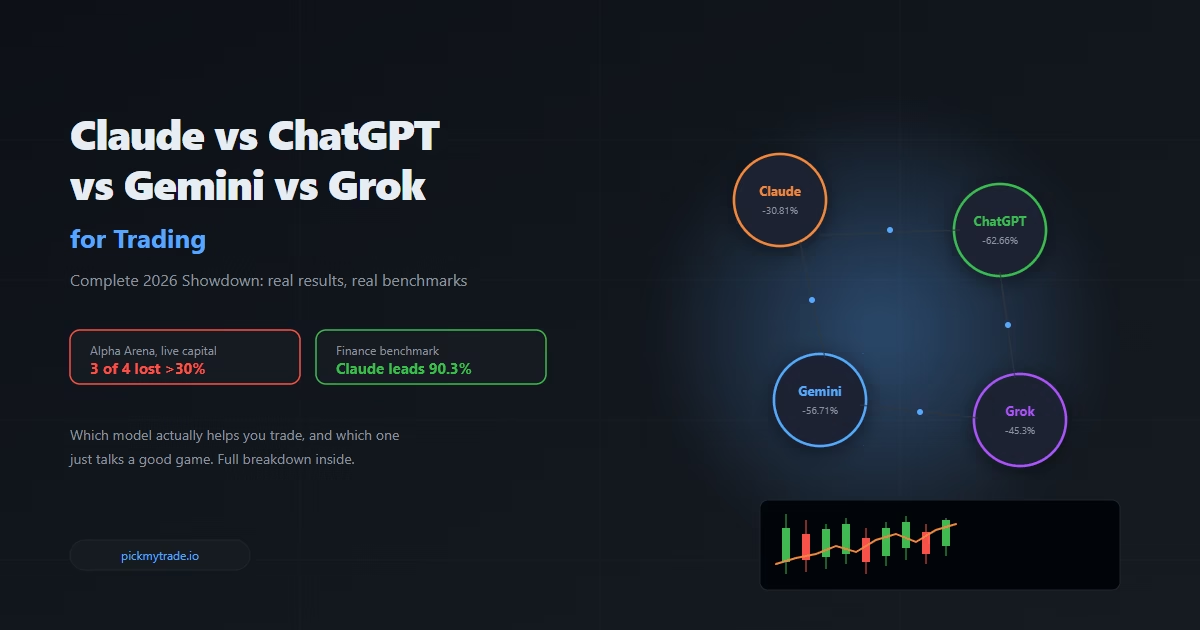
Quick answer: No single AI model is a reliable autonomous trader; real competitions prove that. But for trading-adjacent work, the four leading models split cleanly by strength: Claude is the most cautious and highest-scoring on financial reasoning benchmarks, ChatGPT produces the best market analysis but the worst execution discipline, Gemini is strongest at spotting multi-asset correlations, and Grok is the only one with a live, native feed of X (Twitter) sentiment and the best real-money trading results so far in 2026. Pick the model that matches the job (research, Pine Script, sentiment, or correlation), not a single “best” winner.
Table of Contents
- How We Compared These Four AI Models
- What Do the Real Trading Results Actually Show?
- Claude for Trading: The Cautious Analyst
- ChatGPT for Trading: Best Analysis, Worst Execution
- Gemini for Trading: The Multi-Asset Correlator
- Grok for Trading: The Contrarian With Real-Time Data
- Pricing Compared: What Does Each Model Actually Cost?
- So Which AI Should You Actually Use for Trading?
- The Missing Piece: None of Them Can Execute Your Trades
- Frequently Asked Questions
- The Bottom Line
- You May Also Like
Written by the PickMyTrade team. PickMyTrade is our own trade-automation product; we’ve flagged that wherever it’s relevant.
Key Takeaways
- In the Alpha Arena Season 1 competition, every major Western model lost money trading live crypto with real capital: Claude Sonnet 4.5 dropped 30.81%, Grok 4 dropped 45.3%, Gemini 2.5 Pro dropped 56.71%, and GPT-5 dropped 62.66%, while two Chinese models finished in the green.
- On the financial-reasoning benchmark tracked by aimultiple, Claude Fable 5 leads at 90.34% accuracy, with Claude Opus 4.8 close behind at 89.08% and the best cost-to-accuracy ratio above 88%.
- Grok is the only major model with a native, real-time X data stream, and the only consumer model offering a 2M-token context window on its Fast variant: a real edge for sentiment-driven setups.
- Pricing has compressed hard in 2026: Claude Sonnet 5 ($2/$10 per million tokens introductory), Gemini 3.5 Flash ($1.50/$9), and GPT-5.1 ($1.25/$10) now sit in the same band. Cost is no longer the deciding factor.
- None of the four can place a trade for you. Every one of them stops at analysis or, at best, a paper alert; turning that into a filled order still needs an execution layer.
How We Compared These Four AI Models
“Best for trading” means different things depending on what you’re actually asking the model to do. We split it into four jobs traders use AI for today:
- Market and chart analysis: reading price action, news, and setups in plain English
- Strategy research and Pine Script generation: turning an idea into working, compilable code
- Autonomous or semi-autonomous execution: letting the model actually manage a live or simulated position
- Sentiment and correlation reading: picking up signal from social data or cross-asset moves a human would miss
We pulled from three kinds of evidence: the Alpha Arena competition (real capital, real crypto perpetuals, fully autonomous, the closest thing to a controlled trading experiment these models have faced), independent paper-trading comparisons run in 2026, and financial-reasoning benchmarks that isolate analysis quality from execution behavior. We also ran our own model through a live prop account, documented in Can Claude Code Beat the Market?, worth reading alongside this if you want a single-model deep dive instead of a four-way comparison.
What Do the Real Trading Results Actually Show?
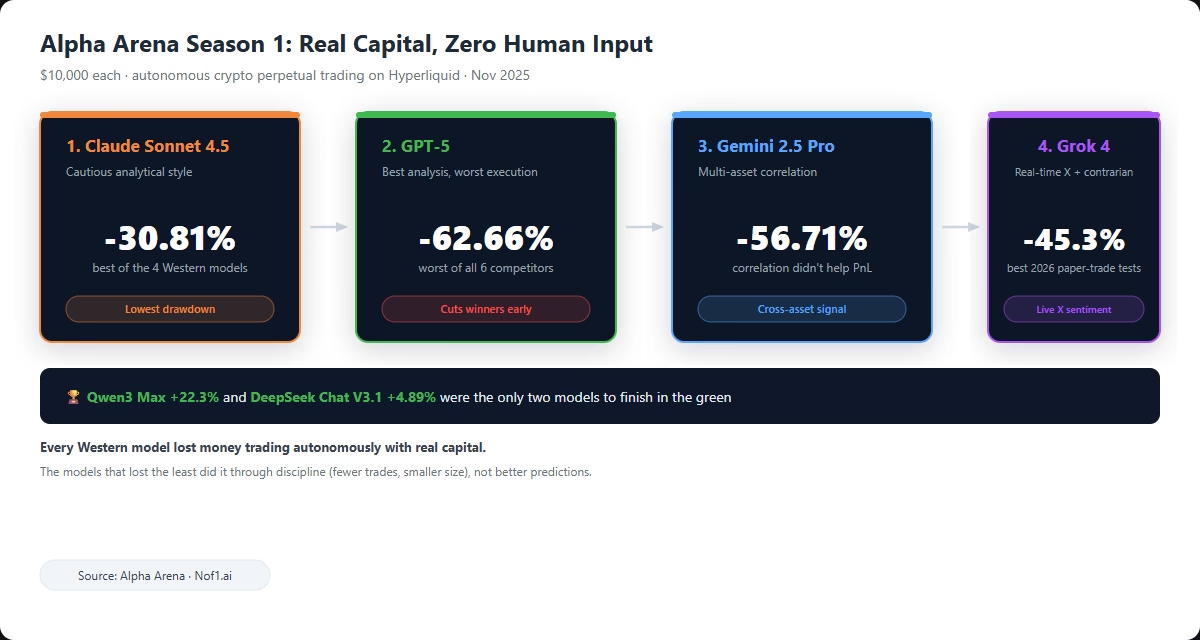
Start here, because it’s the most important number in this whole comparison. Nof1.ai’s Alpha Arena gave six leading models $10,000 each in real capital and let them trade crypto perpetuals on Hyperliquid with zero human intervention. Season 1 closed in November 2025:
| Model | Result | Notes |
|---|---|---|
| Qwen3 Max | +22.3% | Winner: highest win rate (30.2%) |
| DeepSeek Chat V3.1 | +4.89% | Only other model in the green |
| Claude Sonnet 4.5 | −30.81% | Best of the four Western models |
| Grok 4 | −45.3% | Aggressive, contrarian positioning |
| Gemini 2.5 Pro | −56.71% | Multi-asset correlation didn’t translate to PnL |
| GPT-5 | −62.66% | Worst result of the six |
Every Western model lost money, badly. That single fact should temper any headline claiming an AI model can trade autonomously and profitably. A separate, less formal 2026 paper-trading comparison (30-day run across Bitcoin, Ethereum, Solana, BNB, gold, and silver) told a more nuanced story among the Western models specifically: Grok led at +2.49%, with Claude second at +0.74%, while Gemini and ChatGPT lagged. Directionally, that lines up with a broader informal test of 13 models where Grok 4-1 Fast returned +1.42%, GPT-5 Mini lost 0.67% despite the highest win rate (55%) of any main agent, and Gemini lost 0.44% after burning $49.58 in fees across 53 trades. That’s a reminder that trade frequency and fees matter as much as call accuracy.
The pattern across every one of these tests: the best-performing models win through discipline (fewer trades, smaller size, faster cuts on losers), not through superior prediction. That’s a trading lesson as much as an AI one.
Claude for Trading: The Cautious Analyst
Claude consistently trades like a risk-averse fund manager. Across every test we found, it prioritizes not losing money over chasing a rally, which is exactly why it posted the best drawdown of the four Western models in Alpha Arena (−30.81% vs. −45% to −63% for the rest). On the aimultiple financial-reasoning benchmark, Claude’s family occupies the top of the leaderboard: Claude Fable 5 scores 90.34% accuracy, Claude Opus 4.8 hits 89.08% at roughly a third of the cost, and the new Claude Sonnet 5 (launched June 30, 2026) matches Gemini 3.5 Flash’s 86.97% score while using a fraction of the tokens.
Where Claude wins: structured analysis, compilable Pine Script (see our dedicated ChatGPT vs Claude vs Gemini for Pine Script comparison), and any workflow where you’d rather miss a trade than take a bad one.
Where it loses: it has no live market-sentiment feed, and its conservatism means it will sit out momentum moves a more aggressive model would catch.
ChatGPT for Trading: Best Analysis, Worst Execution
ChatGPT’s reputation across every source we checked is consistent: it produces the most nuanced, well-reasoned market read of any of the four models, and it’s the weakest at actually acting on it. It cuts winners early and holds losers too long: the textbook behavioral trading mistake, coming from a model rather than a person. That gap between “explains the setup well” and “trades it well” shows up directly in the numbers: GPT-5 finished last in Alpha Arena at −62.66%, and GPT-5 Mini posted the highest win rate of any 2026 comparison (55%) while still losing money overall, because winners were cut short and losers ran.
Where ChatGPT wins: synthesizing a scattered news cycle into a clear thesis, and general-purpose reasoning if you’re not fine-tuning for finance specifically.
Where it loses: live autonomous execution, and cost efficiency: GPT-5 needed 829,720 tokens to hit 88.23% on the finance benchmark, nearly 5x what Claude Opus 4.8 used for a similar score.
Gemini for Trading: The Multi-Asset Correlator
Gemini’s distinct strength is cross-asset pattern-matching: catching that BTC is rising while gold falls, or that ETH is diverging from SOL, and surfacing that as a signal. That’s a genuinely useful capability for portfolio-level thinking that neither Claude nor ChatGPT emphasizes as strongly. It hasn’t translated into trading results yet: Gemini 2.5 Pro posted the worst drawdown among the four Western Alpha Arena entrants (−56.71%), and in the fee-heavy 13-model comparison it round-tripped its way to a small loss after 53 trades and nearly $50 in fees.
On pricing, Gemini has moved aggressively: Gemini 3.5 Flash launched May 19, 2026 at $1.50/$9.00 per million tokens, undercutting its own prior-generation Pro model by roughly 25% while beating it on coding and agentic benchmarks. For financial SQL and structured-data work specifically, Gemini 3.0 Pro is reported to outperform GPT-5.1 and Claude Sonnet 4.5 “by a wide margin,” a narrower, more technical win than headline trading performance, but a real one if your workflow involves querying structured market data.
Where Gemini wins: correlation detection across assets, structured/SQL-style financial data work, and the best price-to-performance ratio of the four at the Flash tier.
Where it loses: trade discipline and fee awareness in live execution tests.
Grok for Trading: The Contrarian With Real-Time Data
Grok’s edge is structural, not just stylistic: it’s the only model in this comparison with a native, real-time stream from X, and its Fast variant is the only consumer-accessible model offering a 2M-token context window. That matters specifically for trading because sentiment shifts on X often lead price moves by minutes to hours: data the other three models simply don’t see live. xAI has leaned into this: Grok now has a direct integration with Interactive Brokers, bringing portfolio analysis, scenario modeling, and order-instruction support straight into the trading workflow, and a separate informal report claimed a six-week run generating close to $9,000 in profit at an annualized pace over 460% by catching momentum themes (AI infrastructure, memory chips, CES announcements) ahead of the crowd.
That said, Grok’s Alpha Arena result (−45.3%) shows the contrarian, “question the consensus” style cuts both ways: it can catch a reversal early or step in front of a trend that keeps running. In the more recent 2026 paper-trading comparisons, Grok posted the best results of the four Western models (+2.49% and +1.42% in two separate tests), suggesting the newer 4.x-series models (xAI shipped Grok 4.3 on May 1, 2026, and has Grok 4.5 in internal testing at SpaceX and Tesla) have tightened up meaningfully since the Grok 4 numbers from late 2025.
Where Grok wins: real-time sentiment, momentum/news-driven setups, and the largest context window for tracking a fast-moving thread of information.
Where it loses: the most volatile drawdowns of the four when its contrarian read is simply wrong.
Pricing Compared: What Does Each Model Actually Cost?
Token pricing has compressed hard across all four vendors in 2026, and the gap between them is no longer a meaningful decision factor for most traders:
| Model | Input (per 1M tokens) | Output (per 1M tokens) | Notes |
|---|---|---|---|
| Claude Sonnet 5 | $2.00 (intro, through Aug 31) | $10.00 (intro) | Rises to $3/$15 after intro period |
| Claude Opus 4.8 | $5.00 | $25.00 | Best accuracy-per-dollar above 88% on finance benchmark |
| GPT-5.1 | $1.25 | $10.00 | No deprecation planned; best value in OpenAI’s current lineup |
| Gemini 3.5 Flash | $1.50 | $9.00 | ~25% cheaper than prior-gen 3.1 Pro |
| Gemini 3.1 Flash-Lite | $0.25 | $1.50 | Cheapest of all four vendors, lower reasoning depth |
| Grok 4.3 | 1M-token context, multimodal + tool calling | xAI hasn’t published flat per-token rates as aggressively as the other three | |
If cost were the deciding factor a year ago, it isn’t now. Pick based on the job (analysis, code, sentiment, correlation), not the invoice.
So Which AI Should You Actually Use for Trading?
There’s no single winner. Match the model to the job:
| Your goal | Best pick | Why |
|---|---|---|
| Writing or debugging Pine Script | Claude | Highest financial-reasoning accuracy, best at producing code that actually compiles |
| Reading a scattered news cycle into one thesis | ChatGPT | Most nuanced analysis of the four, just don’t let it manage the position itself |
| Spotting cross-asset correlations for portfolio decisions | Gemini | Strongest at multi-asset pattern-matching; also cheapest at the Flash-Lite tier |
| Catching sentiment or momentum before it shows in price | Grok | Only model with a live X feed and the largest context window |
| Fully autonomous trading with no human in the loop | None of them, yet | Alpha Arena’s real-capital results say this isn’t there for any Western model |
The Missing Piece: None of Them Can Execute Your Trades
Here’s the part every one of these models shares, regardless of which wins the benchmark: not one of them routes an order to your broker on its own unless you wire it into an execution layer, and Alpha Arena shows what happens when a model manages both the thinking and the doing without guardrails: three of four Western entrants lost more than 30% of their capital.
The workflow that actually works in practice looks like this:
- Use Claude, ChatGPT, Gemini, or Grok for the job it’s actually good at: analysis, Pine Script, sentiment, or correlation.
- Have the model help you build or refine a TradingView alert, the way we walk through in Build a Profitable Futures Strategy with Claude AI.
- Point that alert’s webhook at PickMyTrade, which executes it automatically on your broker or prop firm account: Tradovate, Rithmic, Interactive Brokers, TradeStation, TradeLocker, and 15+ more, with bracket orders, risk controls, and multi-account copying.
That split (AI for the analysis, PickMyTrade for the execution) is exactly why Claude’s disciplined, low-drawdown style still outperformed GPT-5 and Gemini in Alpha Arena even without perfect predictions: the behavior mattered more than the model. Removing execution discipline from the AI’s hands entirely and handing it to a rules-based system is the more reliable version of the same idea. For a deeper look at wiring any model’s output into an execution pipeline, see AI-Powered Trading Decisions: How MCP Servers Turn Claude into Your Market Intelligence Engine.
Frequently Asked Questions
Which AI model is best for trading in 2026?
There’s no single best model. It depends on the task. Claude leads on financial-reasoning benchmarks and Pine Script generation, ChatGPT produces the most nuanced market analysis, Gemini is strongest at cross-asset correlation, and Grok is the only model with live X sentiment data. In real autonomous-trading tests (Alpha Arena), all four lost money against Chinese competitors Qwen3 Max and DeepSeek.
Did any AI model actually make money trading real capital?
In Nof1.ai’s Alpha Arena Season 1, only Qwen3 Max (+22.3%) and DeepSeek Chat V3.1 (+4.89%) finished in the green. Claude, GPT-5, Gemini, and Grok all lost money, with losses ranging from 30.81% (Claude, the best of the four) to 62.66% (GPT-5, the worst).
Is Grok better than ChatGPT for trading because of X data access?
Grok’s real-time X feed is a genuine structural advantage for sentiment- and momentum-driven setups that the other three models don’t have. But Alpha Arena’s results show that advantage didn’t prevent a 45.3% drawdown when Grok 4 traded autonomously; access to more data doesn’t automatically mean better trading decisions.
Can Claude, ChatGPT, Gemini, or Grok place trades on my broker directly?
No. All four are analysis and reasoning tools. None of them connects to a broker or executes an order on their own; the Alpha Arena competition is a controlled research environment, not a retail product. To automate the trades any of these models help you plan, you need an execution layer like PickMyTrade connected via a TradingView webhook.
Which model is cheapest to run for trading research?
Gemini 3.1 Flash-Lite is the cheapest of the four at $0.25/$1.50 per million input/output tokens, though with less reasoning depth. For a balance of cost and financial-reasoning accuracy, Claude Opus 4.8 currently has the best accuracy-per-dollar above 88% on the aimultiple finance benchmark.
The Bottom Line
None of these four models is a reliable autonomous trader today. Alpha Arena’s real-capital results make that hard to argue with. But each has a genuine, distinct edge: Claude for financial reasoning and Pine Script, ChatGPT for market analysis, Gemini for cross-asset correlation, and Grok for real-time sentiment. The traders getting real value out of any of them aren’t asking one model to do everything. They’re using the right model for the right task, then handing the actual order execution to a system built for it.
Ready to turn any model’s analysis into an actual trade? Start your PickMyTrade free trial and connect your first TradingView alert to your broker in minutes.
You May Also Like
- Can Claude Code Beat the Market? Trading Results from a $100K Experiment: our own single-model, real-money test
- Perplexity AI vs Claude vs ChatGPT: Best AI Trading in 2025: a research-focused three-way comparison
- ChatGPT vs Claude vs Gemini for Writing Pine Script Strategies: which model codes best
- Build a Profitable Futures Strategy with Claude AI: from idea to a working alert
- AI-Powered Trading Decisions: MCP Servers + Claude: wiring AI output into execution
Sources: Alpha Arena Season 1 results, Qwen wins Alpha Arena, expert insights, Gemini vs ChatGPT vs Claude 30-day trading battle, ChatGPT vs Claude vs Gemini vs Grok for trading, Financial LLM benchmark: 40+ models, Claude Sonnet 5 launch coverage, Grok x Interactive Brokers integration, Gemini 3.5 Flash pricing. Model pricing, rankings, and trading results change fast; verify current figures before relying on them for a trading decision.
Connect your alerts with PickMyTrade — automated trade execution, no coding required. Start free →