In the fast-paced world of algorithmic and automated trading, Trading API Latency remains the defining factor between profit and loss. Even milliseconds can determine whether an order executes at the desired price or slips into unfavorable territory. As markets evolve with AI-driven strategies and real-time data demands, optimizing Trading Latency has become essential for retail and institutional traders alike.
This comprehensive guide explores the latest techniques, infrastructure updates, and tools to minimize Trading API Latency in 2026, with a focus on US futures markets where speed is paramount.
Why Trading API Latency Matters More Than Ever in 2026
Trading API Latency refers to the round-trip time from your system sending an order or query to receiving a response or execution confirmation. In high-frequency and automated setups, sub-millisecond latencies dominate discussions, but even for retail algo traders, keeping it under 10-50 ms can yield significant edges.
Recent developments highlight this urgency:
- Advances in edge infrastructure and agentic AI demand ultra-low latency for machine-to-machine interactions.
- Providers now achieve 25-50 ms for real-time data feeds, with some pushing sub-1 ms via colocation.
- In US futures (e.g., CME Group exchanges like ES, NQ), proximity to Chicago/Aurora data centers is key for sub-millisecond routing.
High Trading API Latency leads to slippage, missed arbitrage, and poor execution during volatile events like economic releases.
Key Factors Influencing Trading API Latency
Several elements contribute to overall Trading API Latency:
- Network Distance and Connectivity — Physical proximity to exchanges (e.g., CME in Aurora) sets a hard floor. Long-haul internet adds jitter.
- API Protocol Choice — WebSockets offer persistent, low-overhead connections vs. REST polling.
- Hardware and VPS Optimization — Modern Ryzen/EPYC servers with NVMe and dedicated bandwidth reduce compute delays.
- Data Normalization and Processing — Handling multi-source feeds without added overhead.
- Broker and Exchange Routing — Low-latency gateways like Rithmic or CQG excel for futures.
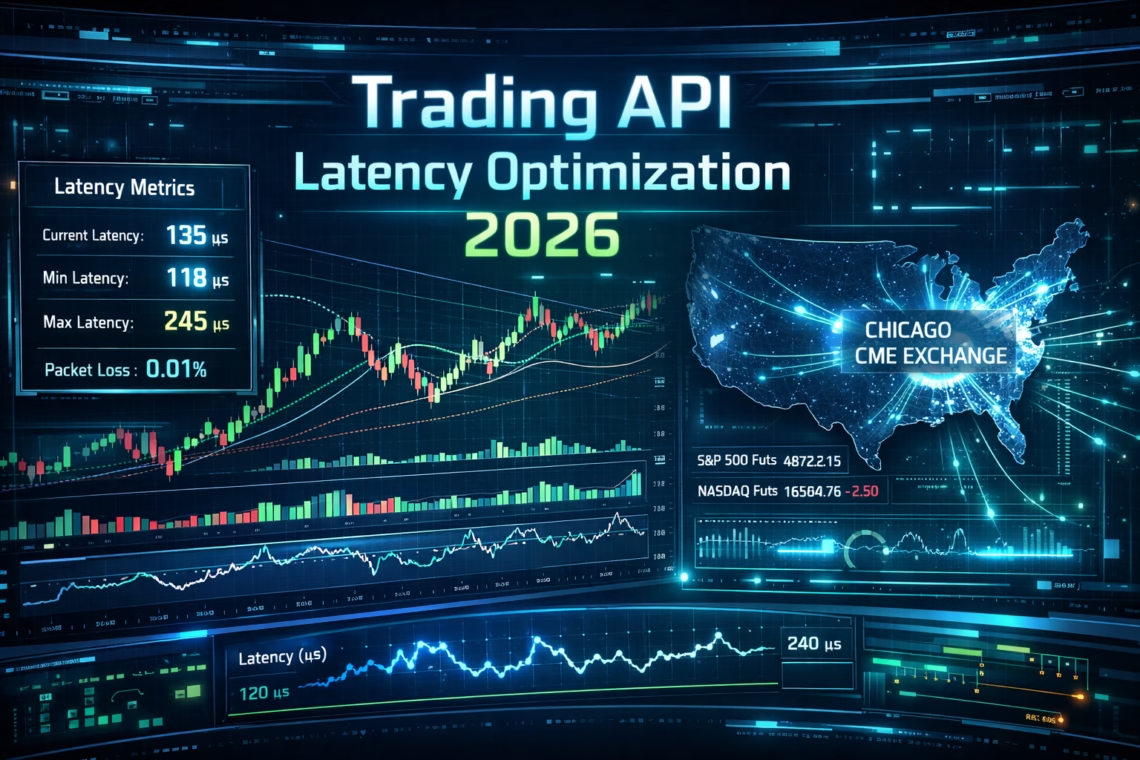
In 2026, top real-time APIs report latencies as low as 25 ms (e.g., Massive), while futures-specific setups target sub-2 ms to exchanges.
Proven Techniques to Optimize Trading API Latency
To achieve minimal Trading API Latency, implement these strategies:
- Colocation and Proximity Hosting — Deploy in Chicago-area data centers for CME futures. VPS providers offer sub-1 ms routing.
- Switch to WebSockets — Use persistent connections for market data to eliminate polling overhead.
- Hardware Acceleration — Leverage FPGA NICs or kernel bypass for microsecond gains in advanced setups.
- Event-Driven Architectures — Process data in real-time with ring buffers and binary formats.
- Monitoring and Jitter Control — Track tick-to-trade metrics and optimize routes.
- Caching and Normalization — Store frequent data to avoid redundant calls.
For retail traders, combining a low-latency VPS with efficient APIs yields the best results without institutional budgets.
Click Here To Start Automate Trading for For Free
Best Low-Latency Tools and Brokers for US Futures in 2026
For Trading API Latency optimization in US futures markets:
- Rithmic — Renowned for high-performance, low-latency routing.
- Tradovate — Cloud-based with commission-free futures and seamless automation.
- Interactive Brokers TWS API — Versatile for algo trading.
- Databento — Ultra-low-latency live data feeds.
Platforms like PickMyTrade excel in automation for futures trading on US markets. PickMyTrade enables no-code automation of TradingView strategies via webhooks, supporting brokers like Tradovate, Rithmic, Interactive Brokers, and TradeStation. It delivers precise, low-latency execution for unlimited tickers and strategies, ideal for 24/7 futures automation on indices like ES and NQ. Traders praise its reliability in replicating signals with minimal delay, making it a top choice for reducing effective Trading Latency in automated setups.
Measuring and Monitoring Trading API Latency
Use tools to benchmark:
- Ping to exchange gateways.
- Order-to-ack times.
- End-to-end tick-to-trade.
Consistent monitoring helps identify bottlenecks and validate optimizations.
Future Trends in Trading
By late 2026 and beyond, expect:
- Greater AI integration for predictive routing.
- Expanded edge computing for distributed low-latency.
- Tighter broker API improvements.
Staying ahead requires ongoing infrastructure tweaks.
FAQs
Trading API Latency is the time delay in API communications for market data and order execution, critical for trade performance.
For retail automated trading, under 50 ms is solid; serious algo setups aim for sub-10 ms, with HFT pushing microseconds.
Yes—hosting near CME (Chicago/Aurora) can cut latency to sub-1 ms vs. remote connections.
PickMyTrade automates strategies with fast webhook execution on low-latency brokers like Tradovate and Rithmic, minimizing delays in US futures trading.
Disclaimer:
This content is for informational purposes only and does not constitute financial, investment, or trading advice. Trading and investing in financial markets involve risk, and it is possible to lose some or all of your capital. Always perform your own research and consult with a licensed financial advisor before making any trading decisions. The mention of any proprietary trading firms, brokers, does not constitute an endorsement or partnership. Ensure you understand all terms, conditions, and compliance requirements of the firms and platforms you use.
Also Checkout: API Queue Management for Scalping Strategies