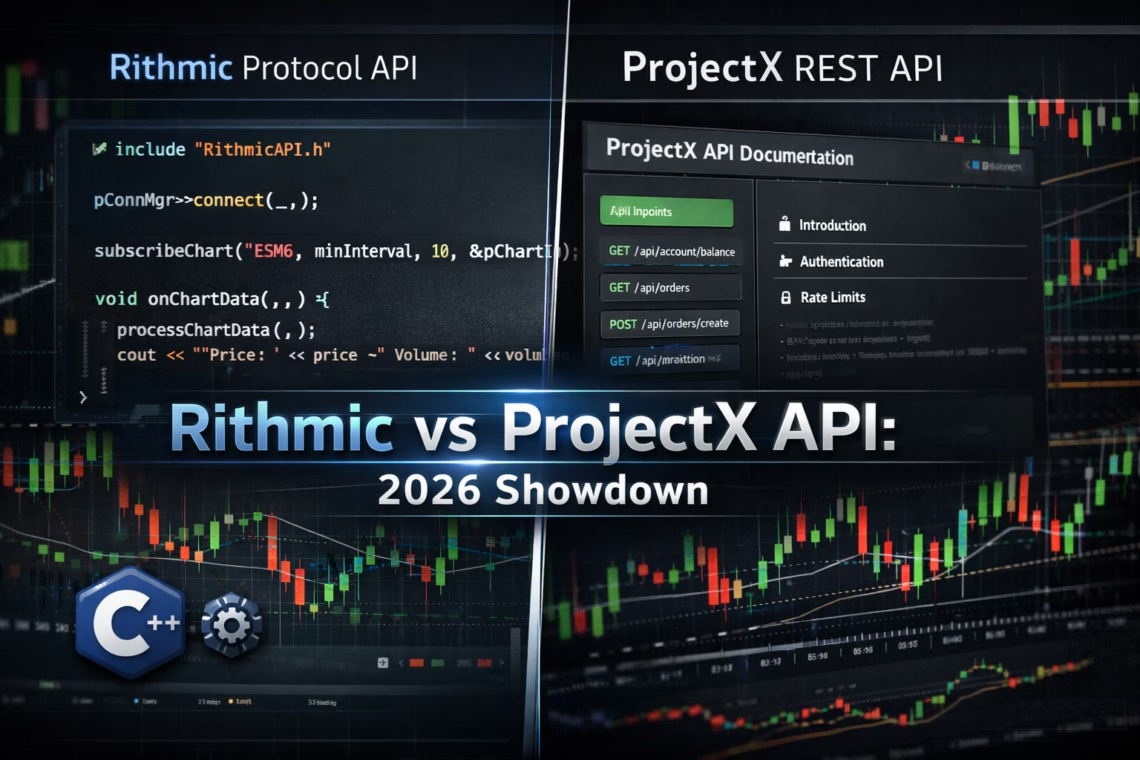
In the fast-evolving world of futures trading, especially for prop firm traders and algorithmic enthusiasts, choosing the right platform often comes down to developer-friendliness. Rithmic vs ProjectX stands out as a key debate, particularly when evaluating API documentation quality, accessibility, and support for automation.
This in-depth comparison explores Rithmic vs ProjectX API documentation, recent updates, strengths, and how tools like PickMyTrade enhance automation on US futures markets.
Understanding Rithmic and ProjectX in Futures Trading
Rithmic is a veteran in direct market access (DMA), renowned for ultra-low latency execution and high-frequency capabilities. It powers many prop firms and independent setups with its R | Protocol API™, R | API+™, and advanced variants like R | Diamond API™.
ProjectX, a modern prop-focused platform, offers built-in risk management, account customization, and scalability for evaluation providers. Its ProjectX Gateway API uses REST architecture, making it approachable for managing prop operations and trading.
Both support US futures markets, but their APIs target different users: Rithmic for performance-driven developers, ProjectX for prop firm management and straightforward integration.
Rithmic API Documentation: Depth for Advanced Developers
Rithmic’s documentation centers on its R | Protocol API™ (wire-line spec) and R | API+™ (libraries for C++/.NET). Access requires requesting dev kits via their site ([email protected] for queries).
Key aspects:
- Normalized market data, order/execution reports across exchanges.
- Microsecond timestamps for latency calculations.
- Advanced features in R | API+™ like custom bars, server-side trailing stops, OCOs, and brackets.
- Third-party wrappers thrive, such as async_rithmic (Python asyncio client) and rithmic-rs (Rust library with recent updates adding order history, risk management, and symbol search).
Recent updates include server-side copy trading (faster order duplication) and ongoing community enhancements in open-source clients. However, official docs are not publicly browsable—developers request access, leading to a gated, protocol-heavy experience suited for pros but less beginner-friendly.
Click Here To Start Futures Trading Automation For Free
ProjectX API Documentation: Modern, Accessible, and RESTful
ProjectX shines with open, well-structured docs at gateway.docs.projectx.com. It supports platforms like The Futures Desk and TopstepX.
Highlights:
- REST API for account management, orders, positions, trades, and market data.
- Clear “Getting Started” guides, including placing your first order with cURL/Postman examples.
- Comprehensive reference sections for endpoints (e.g., /api/Order/place, trade search).
- Python SDK (project-x-py) with async order management.
- API dashboard for subscriptions ($29/mo noted in integrations).
As of 2026, docs remain current, with detailed examples, authentication flows, and prop-specific features like risk rules. It’s more intuitive for REST developers—no protocol buffers or low-level wire specs required.
Rithmic vs ProjectX: Which Has Better API Documentation?
ProjectX edges out with superior documentation in 2026. Its public, searchable, example-rich REST docs lower the entry barrier, ideal for quick prototyping and prop automation.
Rithmic offers deeper, performance-oriented details but remains gated and complex—better for experienced devs needing HFT/low-latency tweaks. Community libs help, yet official access screening slows onboarding.
For most traders (especially prop-focused), ProjectX wins on clarity and speed-to-implementation.
Integrating PickMyTrade for Automation on US Futures Markets
Automation elevates both platforms. PickMyTrade excels here, connecting TradingView alerts to live orders on Rithmic, ProjectX, Tradovate, and more—perfect for US futures like ES, NQ, CL.
- With Rithmic, leverage low-latency for precise HFT-style automation.
- With ProjectX, use built-in risk tools alongside PickMyTrade for disciplined prop eval scaling.
- PickMyTrade slashes manual delays, reduces slippage (up to 70% in tests), and supports multi-account strategies.
Whether choosing Rithmic vs ProjectX, PickMyTrade bridges strategy to execution seamlessly.
Final Verdict: Rithmic vs ProjectX API Documentation Winner
If prioritizing accessible, modern docs for faster development and prop management—ProjectX has better API documentation. For raw power and advanced customization (with solid community support), Rithmic remains elite.
Test both via prop firms or demos, and automate with PickMyTrade for peak performance in US futures.
Most Asked FAQs on Rithmic vs ProjectX
ProjectX, thanks to its RESTful, public docs and straightforward examples.
Yes, request dev kits from Rithmic; it’s screened for qualified developers.
Yes—PickMyTrade supports direct integration with Rithmic and ProjectX for TradingView automation on US futures.
Requires subscription (around $29/mo via dashboard), but docs are freely accessible.
Disclaimer:
This content is for informational purposes only and does not constitute financial, investment, or trading advice. Trading and investing in financial markets involve risk, and it is possible to lose some or all of your capital. Always perform your own research and consult with a licensed financial advisor before making any trading decisions. The mention of any proprietary trading firms, brokers, does not constitute an endorsement or partnership. Ensure you understand all terms, conditions, and compliance requirements of the firms and platforms you use.
Also Checkout: Trade Journaling: Essential Guide for Automated Trading Success