Micro futures contracts sizing is a game-changer for traders seeking precise risk management without committing massive capital. These smaller contracts, offered by the CME Group, allow you to gain exposure to major indices like the S&P 500, Nasdaq-100, Russell 2000, and Dow Jones with just 1/10th the exposure of standard E-mini contracts. Understanding micro contract sizing ensures you avoid oversized positions and optimize your automated trading setups.
As of December 2025, micro E-mini equity futures remain highly liquid, with average daily volumes exceeding 2.4 million contracts in recent quarters (source: CME Group Equity Insights, October 2025). New developments include the launch of micro-sized grains and oilseed futures in February 2025, expanding opportunities beyond equities.
What Are Micro Futures Contracts?
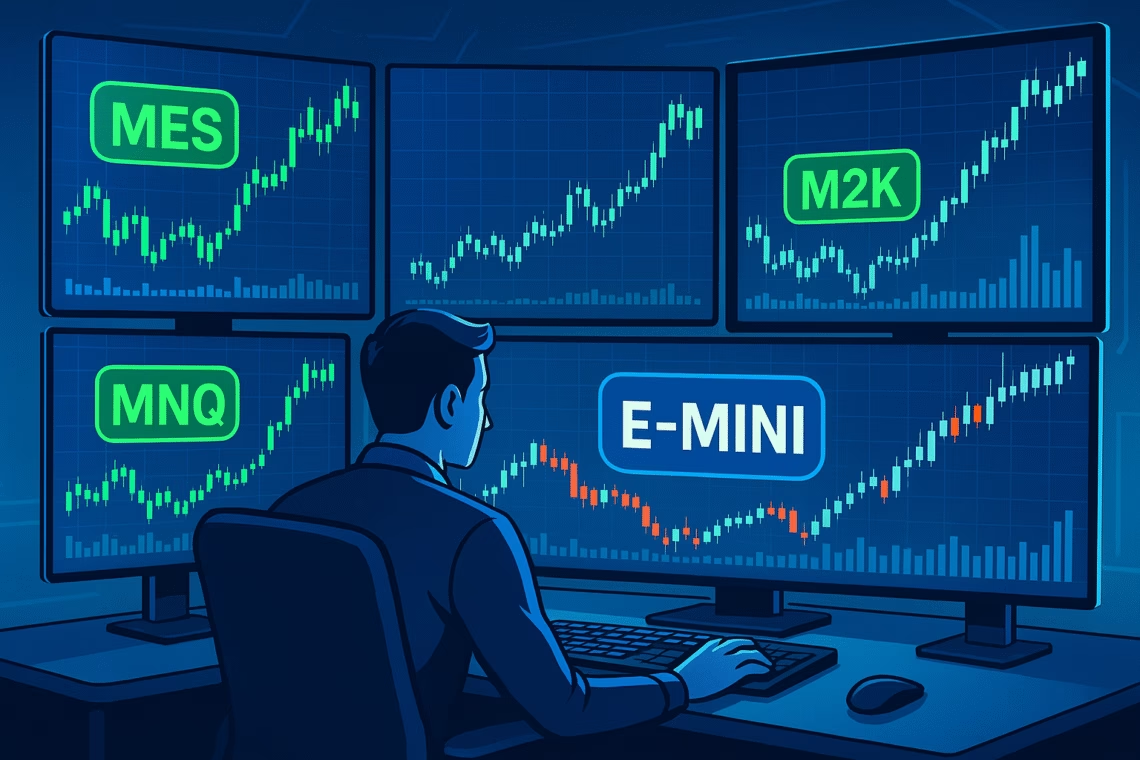
Micro futures are miniaturized versions of popular futures contracts. They track the same underlying index and trade at identical prices but feature a reduced multiplier, resulting in lower notional value and risk per point.
For example:
- Micro E-mini S&P 500 (MES): $5 × S&P 500 Index (vs. $50 for ES). A 1-point move = $5 profit/loss.
- Micro E-mini Nasdaq-100 (MNQ): $2 × Nasdaq-100 Index (vs. $20 for NQ). A 1-point move = $2.
- Micro E-mini Russell 2000 (M2K): $5 × Russell 2000 Index (vs. $50 for RTY).
- Micro E-mini Dow (MYM): $0.50 × Dow Jones Index (vs. $5 for YM).
This 1/10th scaling makes micros ideal for retail traders, algo traders, and those passing prop firm evaluations, where precise sizing prevents blowouts from volatility.
Why Micro Contract Sizing Matters in Trading
Many traders mistakenly assume the displayed chart price reflects full risk. In reality, profit/loss depends on the contract multiplier—not the index level.
Key takeaway: Trading 1 standard E-mini equals 10 micro contracts in exposure. If your strategy risks $100 per trade on ES, switching to MES without adjusting quantity multiplies risk by 10 unless you scale down to 1 contract.
Proper sizing prevents overexposure, especially in automated systems where signals fire rapidly.
Mastering Micro Contract Sizing for Automated Trading
Automation platforms display the index price identically for micro and standard contracts. Your job: Calculate quantity based on risk tolerance.
Example: Risking 1% of a $10,000 account ($100) on MNQ with a 20-point stop.
- MNQ risk per point: $2
- Stop risk: 20 points × $2 = $40 per contract
- Contracts: $100 / $40 = 2.5 (round down to 2 for safety)
Dynamic sizing via risk percentage or fixed dollars keeps trades consistent across micros.
How to Automate Micro Futures with PickMyTrade
PickMyTrade bridges TradingView alerts to brokers like Tradovate, Rithmic, and Interactive Brokers for seamless micro futures execution.
PickMyTrade supports millisecond-precision automation, multi-account management, and advanced features like trailing stops—perfect for micro contract sizing strategies.
(See setup checklist in section 4 below for details.)
Real-World Use Cases for Micro Contract Sizing
Micros shine in scalping, swing trading, and portfolio diversification. Automating with PickMyTrade eliminates manual errors in fast markets.
Benefits vs. Limitations of Micro Futures
Benefits:
- Lower capital requirements and margins
- Precise risk control for smaller accounts
- High liquidity rivaling E-minis
- Ideal for prop firm challenges
Limitations:
- Smaller tick values reduce per-trade profit potential
- Potential for overtrading due to “small” feel
- Not all brokers offer identical margins
Common Mistakes and Fixes
Avoid assuming 1:1 equivalence with E-minis or ignoring multiplier differences.
Common setup pitfalls
- Using the wrong symbol in alerts (e.g., continuous vs. front-month)
- Forgetting to adjust quantity for micro multipliers
- Testing only in demo without verifying live fills
Advanced tips
- Use dynamic quantity in alerts for risk-based sizing
- Layer multiple micros for pyramid entries
- Combine with trailing stops for volatile indices like MNQ
Ready to automate your micro futures strategy? Start with PickMyTrade’s free 5-day trial—no credit card required. Connect TradingView signals to Tradovate, Rithmic, or IBKR in minutes and execute trades 24/7 with precision.
Most-Asked FAQs
MNQ has 1/10th the risk—$2 per point vs. $20 for NQ.
No, futures require whole contracts, but micros’ small size effectively allows fine control.
Yes, typically 1/10th, but check your broker (e.g., intraday as low as $50 for MNQ).
Multiply quantity by 10 when moving to micros for equivalent exposure, or adjust risk %.
Yes, configure risk % in alert generation rules for auto-calculation.
Absolutely—PickMyTrade connects demo/prop credentials seamlessly.
Disclaimer:
This content is for informational purposes only and does not constitute financial, investment, or trading advice. Trading and investing in financial markets involve risk, and it is possible to lose some or all of your capital. Always perform your own research and consult with a licensed financial advisor before making any trading decisions. The mention of any proprietary trading firms, brokers, does not constitute an endorsement or partnership. Ensure you understand all terms, conditions, and compliance requirements of the firms and platforms you use.
Also Checkout: Automated Options Trading: PickMyTrade’s 2025 Edge