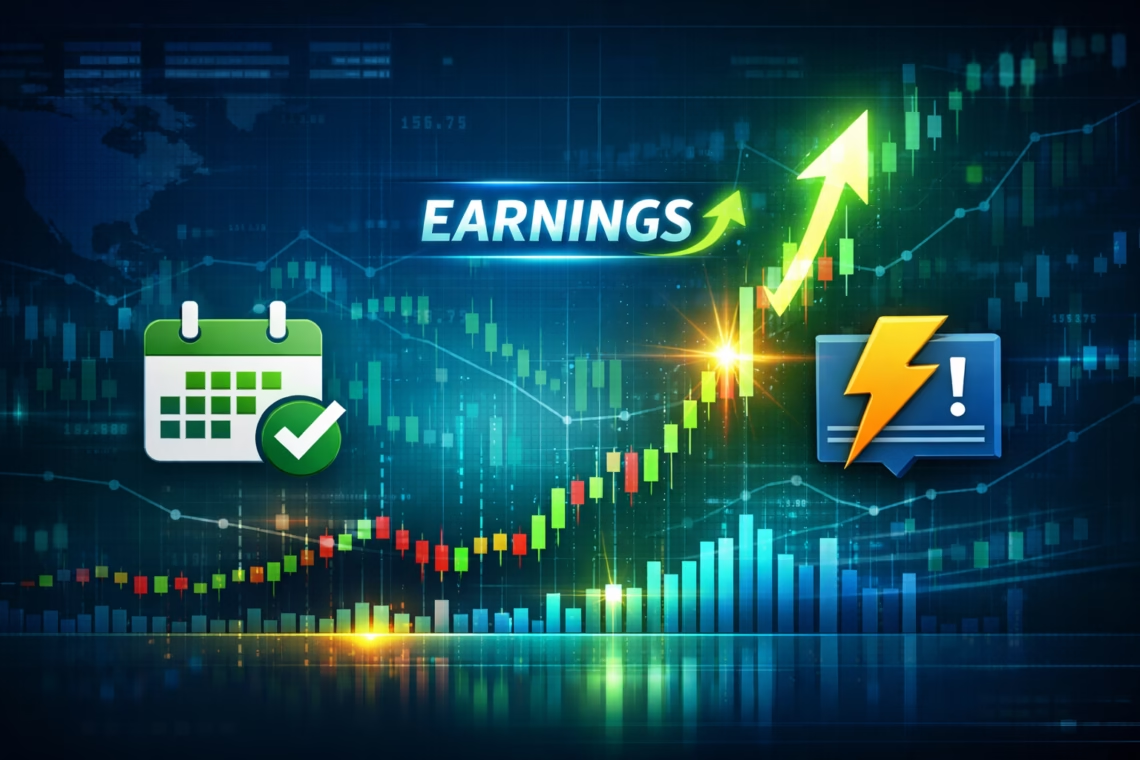
In the fast-evolving world of financial markets, traders constantly seek edges to outperform. Two core approaches dominate trigger mechanisms: time-based trading and Event-Based Trading. While time-based methods rely on fixed intervals or clock-driven signals, Event-Based Trading capitalizes on specific catalysts like earnings reports, mergers, economic data releases, or geopolitical developments to drive price action.
As we move through 2026, Event-Based Trading has gained momentum amid renewed M&A activity, policy volatility from US tariffs, and AI-enhanced event detection. This strategy offers selectivity over constant monitoring, making it ideal for traders aiming for high-impact, lower-frequency opportunities—especially in US futures markets.
Understanding Time-Based Trading Triggers
Time-based trading uses predefined time intervals or schedules to initiate trades. Common examples include:
- End-of-day closes on daily charts.
- Breakouts after specific session times (e.g., market open).
- Indicator crossovers tied to candle closes on fixed timeframes like 5-minute or hourly charts.
This approach suits systematic traders who prefer routine and backtestable rules. However, it can lead to whipsaws in ranging markets or missed opportunities during quiet periods, as it ignores real-time information shocks.
Pros: Predictable, easy to automate with basic rules. Cons: Less adaptive to sudden news; over-relies on historical patterns without context.
What Is Event-Based Trading and Why It Matters in 2026
Event-Based Trading (also called event-driven trading) focuses on profiting from price movements triggered by identifiable events that alter market expectations. Traders wait for catalysts rather than trading continuously.
Key event types include:
- Corporate events — Earnings beats/misses, guidance updates, M&A announcements, FDA approvals.
- Macro events — Economic data (e.g., CPI, jobs reports), central bank decisions.
- Geopolitical or policy shifts — Tariffs, regulatory changes, elections.
In 2026, event-driven strategies thrive due to sustained M&A pipelines, volatility from trade policies, and tools like AI for real-time detection. Hedge funds reported strong performance in event-driven approaches last year, with momentum carrying forward amid normalized regulations and private-equity activity.
Unlike time-based methods, Event-Based Trading emphasizes selectivity—fewer but higher-conviction trades—reducing overtrading and emotional decisions.
Event-Based Trading vs Time-Based Trading: Key Differences
| Aspect | Time-Based Trading | Event-Based Trading |
|---|---|---|
| Trigger Mechanism | Fixed time intervals or clock | Specific real-world catalysts |
| Trade Frequency | Higher, routine | Lower, opportunistic |
| Adaptability | Rigid to schedules | Highly responsive to news/information shocks |
| Risk Profile | Prone to noise in low-volatility | Volatility spikes, but defined risk windows |
| Best For | Trend-following, scalping | Short-term volatility plays, arbitrage |
| 2026 Relevance | Steady in calm markets | Excels in policy/M&A-driven volatility |
Event-Based Trading often outperforms in information-rich environments, as markets reprice rapidly post-event. Time-based approaches shine in technical setups but can lag when events override patterns.
Click Here To Automate Futures Trading
How Event-Based Trading Works: Strategies and Execution
Successful Event-Based Trading involves anticipation, reaction, or post-event positioning.
- Pre-Event Positioning — Build positions ahead of scheduled events (e.g., straddle options for earnings volatility).
- Post-Event Reaction — Enter on confirmed beats/misses or deal announcements.
- Merger Arbitrage — Trade spreads in announced M&As for convergence.
Risks include unpredictable reactions, slippage in fast moves, and competition from institutions. Mitigation: Use stop-losses, size positions conservatively, and leverage data tools.
In 2026, AI platforms scan news and historical reactions for edges, making Event-Based Trading more accessible to retail traders.
Automate Trading in US Futures with PickMyTrade
For US markets, futures like E-mini S&P 500 (/ES), Nasdaq (/NQ), or crude oil offer excellent Event-Based Trading vehicles due to high liquidity and nearly 24/5 trading.
PickMyTrade stands out as a leading automation platform for futures trading automation. It integrates seamlessly with brokers like Tradovate, Rithmic, Interactive Brokers, and others, allowing traders to automate strategies from TradingView alerts via webhooks.
Key features:
- Trigger automated entries/exits on event signals (e.g., post-earnings volatility).
- Low-latency execution for fast US futures markets.
- Support for stocks, futures, options—ideal for event-driven setups.
- No-code setup for alerts on news catalysts.
Traders can backtest event reactions and automate rules, capturing opportunities in volatile sessions without constant monitoring. In 2026’s environment of policy shifts and corporate events, PickMyTrade empowers retail traders to compete effectively in US futures.
Final Thoughts
Event-Based Trading provides a strategic edge by aligning with market realities—prices move most on new information, not arbitrary time ticks. In 2026, with ongoing volatility and technological advancements, this approach offers compelling risk-adjusted returns over purely time-based methods.
Whether manual or automated via tools like PickMyTrade, mastering Trading requires discipline, research, and adaptability. Start small, focus on high-probability catalysts, and watch your trading evolve.
FAQs
Event-Based Trading is a strategy that profits from price movements caused by specific events like earnings, mergers, or economic data, rather than continuous monitoring or time intervals.
Time-based relies on fixed schedules or chart intervals; Event-Based Trading waits for catalysts that create volatility and repricing opportunities.
It requires understanding market reactions and risk management but can be accessible with tools like alerts and automation platforms such as PickMyTrade.
Yes, platforms like PickMyTrade automate TradingView strategies for brokers such as Tradovate and Interactive Brokers, enabling event-triggered trades in futures.
Disclaimer:
This content is for informational purposes only and does not constitute financial, investment, or trading advice. Trading and investing in financial markets involve risk, and it is possible to lose some or all of your capital. Always perform your own research and consult with a licensed financial advisor before making any trading decisions. The mention of any proprietary trading firms, brokers, does not constitute an endorsement or partnership. Ensure you understand all terms, conditions, and compliance requirements of the firms and platforms you use.
Also Checkout: Best Paper Trading Platforms For Algo Traders In 2026