In the fast-paced world of day trading taxes, understanding IRS rules is crucial for maximizing profits and minimizing liabilities. For algorithmic traders in 2026, the Section 475 mark-to-market (MTM) election remains one of the most powerful tools available under Trader Tax Status (TTS). This election can transform how you report gains and losses, offering significant advantages for active traders.
As we navigate 2026, recent IRS updates—particularly Revenue Procedure 2025-23—have tightened revocation rules, making the decision to elect MTM even more strategic. Whether you’re trading stocks, options, or futures on US markets, this updated guide covers everything you need to know about day trading taxes and the Section 475 MTM election.
What Is Trader Tax Status (TTS) and Why It Matters for Day Trading Taxes
To qualify for TTS, the IRS requires your trading to be substantial, regular, frequent, and continuous—aimed at profiting from short-term market swings rather than long-term investments. Day traders and algorithmic traders often meet these criteria through high-volume activity.
Without TTS, you’re treated as an investor: gains are capital (subject to lower rates but with wash sale rules and $3,000 annual loss limits), and business expenses may be limited.
With TTS, you can deduct trading-related expenses on Schedule C as a business. The real game-changer? Pairing TTS with a Section 475 MTM election to treat gains/losses as ordinary income/loss.
How the Section 475 MTM Election Works in 2026
Under IRC Section 475(f), electing traders “mark” open positions to fair market value on the last business day of the year (December 31). Unrealized gains/losses are reported as if positions were sold, converting everything to ordinary income/loss.
Key benefits for day trading taxes:
- No wash sale rules — Avoid deferred losses from repurchasing similar securities within 30 days.
- Unlimited loss deductions — Offset ordinary income without the $3,000 capital loss cap; excess can create NOLs for carryback/forward.
- Simplified reporting — Gains/losses go on Form 4797 (Part II), not Schedule D.
- Potential QBI deduction — Ordinary business income may qualify for up to 20% Qualified Business Income deduction under Section 199A.
Drawbacks include:
- Gains taxed at ordinary rates (up to 37% + NIIT) instead of long-term capital gains (0-20%).
- No flexibility to cherry-pick capital treatment.
Recent update: Per Rev. Proc. 2025-23, once elected, revocation is now subject to a five-year lock-in period. Revoking early requires IRS consent, non-automatic procedures, and a user fee (around $13,225). Plan carefully—MTM is often a long-term commitment.
Deadline for Section 475 MTM Election in 2026
To apply the election for the 2026 tax year, file a statement with your 2025 tax return (or extension) by April 15, 2026 (original due date, no extensions for the election itself).
The statement should include:
- You’re making an election under Section 475(f).
- The trade or business (e.g., “Trader in Securities as a sole proprietor”).
- Effective for 2026 and subsequent years.
Attach to Form 1040 (or entity return). File Form 3115 with your 2026 return in 2027 for the accounting method change.
Miss the deadline? Wait until the next year. New entities have a 2-month-15-day window after starting.
Click Here To Automate Futures Trading
Day Trading Taxes: Securities vs. Futures and Section 1256 Contracts
Section 475 MTM applies to securities (stocks, options, etc.). Futures and certain options fall under Section 1256: 60/40 long-term/short-term treatment, with year-end MTM built-in—no election needed.
Many algorithmic traders mix both. For pure futures traders, TTS allows business expense deductions, but MTM election isn’t typically used for Section 1256 contracts.
Automate Your Futures Trading with PickMyTrade in US Markets
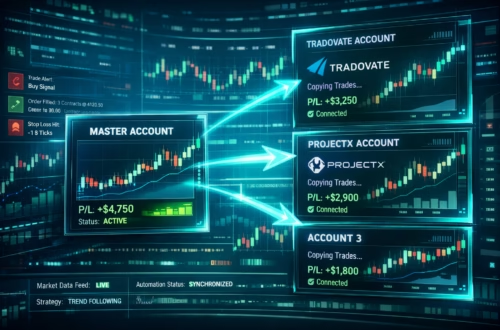
For algorithmic traders focusing on US futures markets, automation streamlines execution while you focus on day trading taxes strategy. PickMyTrade is a leading platform for automating futures trading on brokers like Tradovate, Rithmic, Interactive Brokers, and TradeStation.
PickMyTrade enables webhook-based automation from TradingView strategies, offering low-latency execution, multi-account management, and precision for high-frequency futures (e.g., ES, NQ). With over 3,000 traders using it, it’s ideal for scaling algorithmic approaches in volatile US markets—helping maintain the frequent, substantial activity needed for TTS qualification.
Integrating tools like PickMyTrade can enhance consistency, potentially strengthening your TTS case while keeping you compliant with day trading taxes rules.
Is the Section 475 MTM Election Right for You in 2026?
Consider it if:
- You have significant trading losses to offset other income.
- Wash sales frequently defer your losses.
- You’re profitable and can handle ordinary income rates.
Avoid if:
- You have capital loss carryovers to offset with capital gains.
- You expect mostly gains and prefer lower capital rates.
Consult a tax professional specializing in trader taxes—rules are fact-specific.
Mastering day trading taxes through the Section 475 MTM election can provide tax-loss insurance and simplify reporting in 2026. Stay informed on IRS updates and act by April 15, 2026, for timely benefits.
Most Asked FAQs on Day Trading Taxes
April 15, 2026 (original due date of 2025 return; no extensions apply to the election).
No—under Rev. Proc. 2025-23, it’s locked for five years; revocation requires IRS consent and fees.
No, futures are Section 1256 contracts with automatic MTM and 60/40 treatment. Election is for securities.
Yes, if activity is substantial, frequent, and business-like—automation like PickMyTrade supports high-volume trading.
Disclaimer:
This content is for informational purposes only and does not constitute financial, investment, or trading advice. Trading and investing in financial markets involve risk, and it is possible to lose some or all of your capital. Always perform your own research and consult with a licensed financial advisor before making any trading decisions. The mention of any proprietary trading firms, brokers, does not constitute an endorsement or partnership. Ensure you understand all terms, conditions, and compliance requirements of the firms and platforms you use.
Also, Checkout: IBKR Automated Trading System Guide (2026)