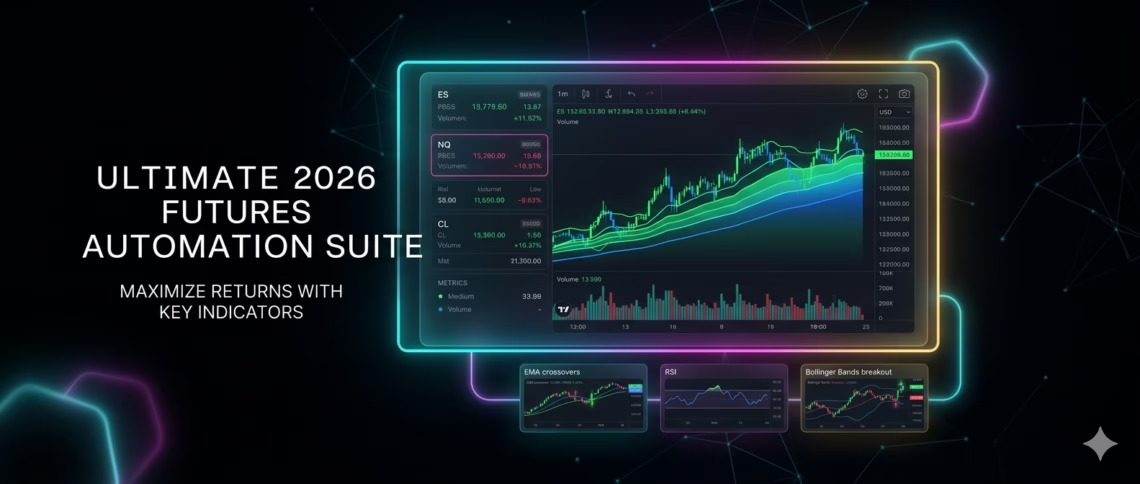
Futures Markets Indicators are the secret weapon for traders seeking consistent edge in volatile US markets like E-mini S&P 500 (ES), Nasdaq-100 (NQ), and Crude Oil (CL). In 2026, automation has transformed how these indicators deliver results—removing emotion, enabling 24/7 execution, and scaling across multiple accounts with millisecond precision.
Whether you trade on the CME or through platforms like Tradovate, the right Futures Markets Indicators programmed into TradingView strategies can run autonomously. This guide reveals the most effective ones for automation, updated with 2026 trends, real-world settings, and how PickMyTrade makes execution effortless on US futures markets.
Why Automate Futures Markets Indicators in 2026?
Manual trading in futures is exhausting. Markets move fast, emotions creep in, and missed signals cost profits. Automation solves this by turning proven Futures Markets Indicators into rule-based systems that execute instantly.
Recent Pine Script v6 updates (late 2025) deliver better non-repainting logic, dynamic requests, and superior backtesting—making automated strategies more reliable than ever. Traders now combine trend, momentum, and volatility tools for higher win rates with strict risk management. Platforms like PickMyTrade bridge TradingView alerts directly to brokers (Tradovate, Rithmic, IBKR), enabling no-code automation for live, demo, or prop accounts.
Result? Faster fills, multi-account scaling, and the ability to trade US futures 23 hours a day without staring at charts.
Top Futures Markets Indicators Perfect for Automation
Here are the best Futures Markets Indicators for automated trading in 2026. Each generates clear, programmable signals ideal for TradingView strategies and PickMyTrade execution.
1. Moving Averages (EMA & SMA Crossovers)
Futures Markets Indicators like EMA (9/21) and SMA crossovers remain king for trend identification. EMA reacts faster to recent price action—perfect for volatile futures.
Why automate? Crossovers trigger instant buy/sell alerts. Use in trending markets (e.g., ES during New York open) with volume confirmation. 2026 tip: Adaptive MAs that adjust to volatility reduce whipsaws. Pair with higher-timeframe filter for 60-70% win rates in backtests.
2. Relative Strength Index (RSI)
RSI (14-period, levels 30/70) spots overbought/oversold conditions and divergences with surgical precision.
Why automate? Program rules like “Buy when RSI crosses above 30 in uptrend” for mean-reversion or trend-continuation setups on NQ or CL. 2026 tip: Multi-timeframe RSI (e.g., 5-min + 15-min confirmation) avoids false signals in choppy sessions.
3. MACD (Moving Average Convergence Divergence)
MACD (12,26,9) with histogram highlights momentum shifts and zero-line crosses.
Why automate? Histogram divergence or signal-line crosses create reliable entries/exits. Excellent for breakout strategies on index futures. 2026 tip: Combine with adaptive settings via Pine Script v6 for non-repainting performance.
4. Bollinger Bands
Bollinger Bands (20-period, 2 SD) measure volatility and identify squeeze breakouts.
Why automate? Price touching bands + expansion triggers high-probability moves. Ideal for range-bound futures turning volatile. 2026 tip: Band-width filters automate “squeeze” alerts—traders report strong results on CL and GC.
Click Here To Automate Futures Trading
5. VWAP (Volume Weighted Average Price) with Deviations
VWAP + standard deviation bands is a futures day-trading staple, showing fair value and intraday bias.
Why automate? Price above/below VWAP defines bullish/bearish bias; bands act as dynamic support/resistance. 2026 tip: Session-based VWAP (regular hours start) combined with volume profile powers professional automated systems.
6. Pivot Points & Prior Day OHLC
Floor-trader pivots (R1-R3, S1-S3) and prior-day high/low/close provide fixed daily levels.
Why automate? Price interaction with pivots or OHLC creates objective breakout/reversal rules—perfect for opening-range strategies. 2026 tip: Automate “pivot breakout + volume confirmation” for high-conviction trades on ES/NQ.
7. Volume Profile & Order Flow Filters
Volume Profile highlights Point of Control (POC) and Value Area—where institutions accumulate.
Why automate? POC acts as magnet; combine with price action for reversal or continuation signals. 2026 tip: NinjaTrader-style order-flow tools or TradingView equivalents add institutional edge when automated.
Automate These Futures Markets Indicators with PickMyTrade on US Markets
Turn any of the above Futures Markets Indicators into live trades in minutes with PickMyTrade. This no-code platform connects TradingView Pine Script strategies or alerts directly to top futures brokers like Tradovate and Rithmic—no API coding required.
Key advantages for US futures traders in 2026:
- Millisecond execution on CME contracts (ES, NQ, CL, GC, etc.)
- Unlimited alerts, multi-account copying, and prop-firm friendly
- Advanced risk tools: SL/TP, % risk sizing, OCO orders
- 24/7 support and seamless webhook integration
Users simply build a strategy (e.g., EMA crossover + RSI filter), set TradingView alerts, paste into PickMyTrade, and watch it run autonomously. Recent reviews highlight 99% fill rates and effortless scaling across funded accounts.
Pro setup tip: Start with a 5-day free trial, backtest on historical futures data, then go live on a demo account.
Best Practices for Automating Futures Markets
- Combine 2-3 indicators (never one alone) for confirmation.
- Backtest rigorously with 2025-2026 data using Pine Script v6.
- Implement strict risk management (1% per trade max).
- Monitor during high-impact events (FOMC, NFP) and pause automation if needed.
- Scale gradually—start small, then copy to multiple accounts via PickMyTrade.
Traders using these Futures Markets Indicators with automation report more consistent results and freed-up time for strategy refinement.
Final Thoughts on Mastering Futures Markets
The best Futures Markets Indicators for automation in 2026 blend simplicity with power: Moving Averages, RSI, MACD, Bollinger Bands, VWAP, Pivots, and Volume Profile lead the pack. When paired with PickMyTrade’s seamless TradingView-to-broker execution on US futures markets, they deliver professional-grade performance without the stress.
Ready to automate? Test these setups today and experience the edge automation provides.
FAQs: Most Asked Questions
Start with EMA crossovers, RSI, and VWAP. They’re simple to understand, easy to automate, and highly effective on US index and commodity futures.
Yes! Use TradingView alerts + PickMyTrade to connect directly to Tradovate or Rithmic—no Pine Script expertise needed for basic setups.
Pivot Points, VWAP, Opening Range, and MACD deliver the strongest intraday signals when automated.
Absolutely. It supports unlimited accounts, risk controls, and works flawlessly with funded Tradovate/Rithmic setups.
Disclaimer:
This content is for informational purposes only and does not constitute financial, investment, or trading advice. Trading and investing in financial markets involve risk, and it is possible to lose some or all of your capital. Always perform your own research and consult with a licensed financial advisor before making any trading decisions. The mention of any proprietary trading firms, brokers, does not constitute an endorsement or partnership. Ensure you understand all terms, conditions, and compliance requirements of the firms and platforms you use.
Also Checkout: Advanced Order Types Futures: FOK, IOC & GTD Explained