In the fast-paced world of futures trading, AI has revolutionized how traders identify opportunities and execute strategies. However, false signals—those misleading indicators that lead to unprofitable trades—remain a persistent challenge. As we enter 2026, advancements in AI signal filtering are empowering traders to reduce false trades and refine their futures strategy for greater precision and profitability. This blog explores cutting-edge techniques, recent updates, and practical tools to help you stay ahead in the markets.
Understanding AI Signal Filtering in Futures Trading
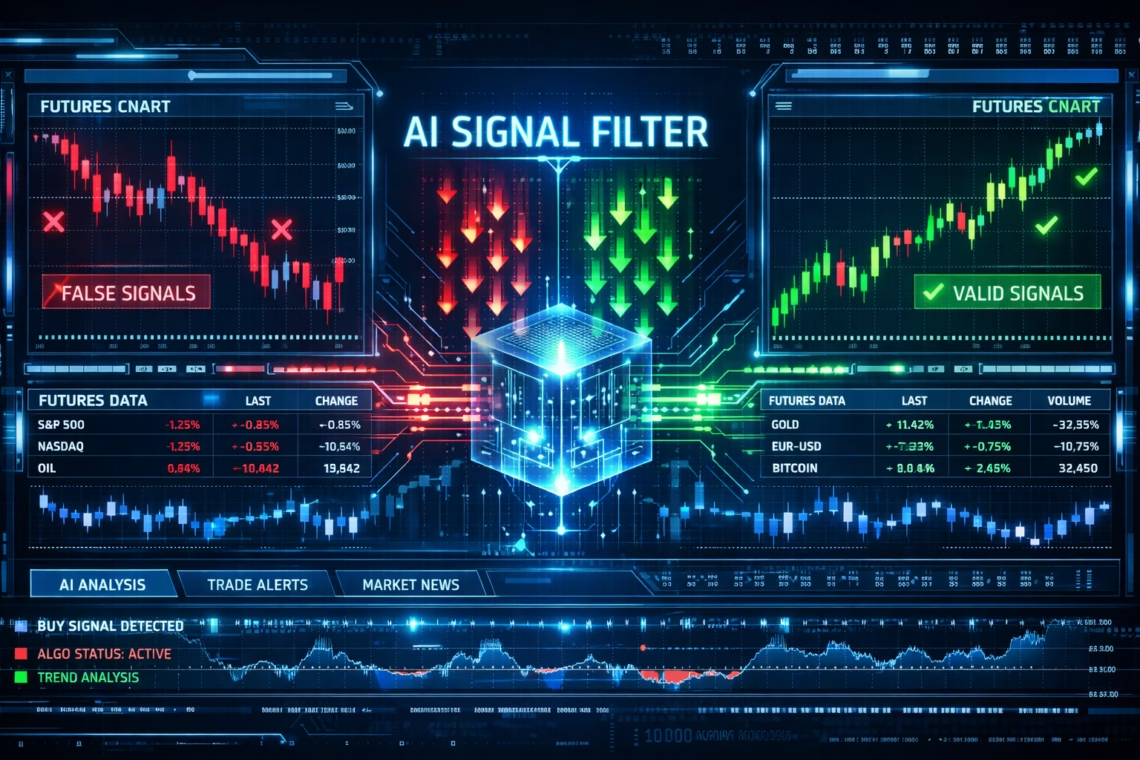
AI signal filtering refers to the process of using artificial intelligence algorithms to sift through vast amounts of market data, distinguishing reliable trading signals from noise. In futures trading, where contracts on commodities, indices, or currencies can fluctuate wildly due to volatility, economic news, or geopolitical events, effective filtering is crucial.
Traditional indicators like moving averages or RSI often generate false positives in choppy markets. AI enhances this by incorporating machine learning models that learn from historical data, adapting to patterns in real-time. For instance, neural networks can analyze sentiment from news feeds and social media, combining them with price action to validate signals. This not only improves accuracy but also aligns with a robust futures strategy focused on high-probability trades.
Why False Trades Occur and Strategies to Reduce False Trades
False trades typically stem from overfitting—where AI models perform well on past data but fail in live markets—or external factors like market noise and low liquidity. In AI-based systems, hallucinations or biased training data can exacerbate this, leading to erroneous entries or exits.
To reduce false trades, start with multi-indicator confirmation: Require signals from at least two complementary tools, such as combining AI-driven trend analysis with volume filters, before executing. Implement strict risk management, including stop-loss orders at 1-2% of capital per trade and position sizing based on volatility. Backtesting with out-of-sample data helps identify overfitting, while incorporating entropy-based filters—like Shannon entropy—quantifies signal reliability to weed out low-information noise. These steps can slash false positives by up to 99% in optimized systems.
Advanced Futures Strategy: Leveraging AI for Signal Accuracy
A top-tier futures strategy in 2026 integrates AI signal filtering with hybrid approaches. For example, use deep learning models for predictive analytics on derivatives, optimizing for volatility in assets like oil or S&P 500 futures. Agentic AI, which autonomously adjusts parameters based on market conditions, is a game-changer, informing trade urgency and sizing without direct order placement.
Combine this with sentiment tools: Large language models (LLMs) now process news and social data to filter signals, enhancing understanding of market drivers. In practice, a strategy might involve AI scanning for breakout patterns, then applying directional filters to avoid entries in range-bound conditions. This reduces false trades while maximizing wins in trending markets.
Click Here to Start Trading Automation For Free
Recent Updates in AI Signal Filtering
From 2024 to 2026, AI advancements have focused on intelligent filtering. In 2025, studies highlighted LLMs for sentiment analysis in derivatives, reducing noise by integrating real-time data. By mid-2025, tools like those from Syntium Algo emphasized AI bots for forex and futures, with benchmarks showing improved P&L through adaptive signals.
In 2026, trends include agentic AI for financial operations, boosting ROI by automating anomaly detection and compliance. Platforms now use entropy and vector quantization for signal optimization, as seen in recent research. Fraud prevention via AI has also evolved, with analytics detecting spoofing to maintain signal integrity. These updates underscore a shift toward hybrid human-AI systems for sustainable futures strategies.
Tools and Platforms: PickMyTrade Automation Trading for AI-Enhanced Futures
To implement AI signal filtering effectively, consider automation platforms like PickMyTrade. This tool automates TradingView strategies to brokers such as Tradovate and Rithmic, enabling no-code execution of AI-generated signals in futures trading. With features like multi-account management and smart risk tools, PickMyTrade helps reduce false trades by filtering alerts based on predefined criteria, such as minimum engagement or volatility thresholds.
Recent 2025 updates position PickMyTrade as a top bot for 2026, outperforming competitors in seamless integration and performance evaluation. For futures traders, it streamlines strategies like MACD-based quick trades, automating entries while incorporating AI filters to avoid noise. Priced at $50/month for unlimited strategies, it’s an accessible way to enhance your futures strategy with reliable signal processing.
Best Practices to Filter False Signals in AI Systems
- Multi-Layer Validation: Cross-verify AI signals with traditional metrics and human oversight to catch biases.
- Market Context Awareness: Avoid trading in low-volume periods; use AI to detect choppy conditions via adaptive oscillators.
- Data Quality Focus: Train models on diverse, up-to-date datasets to minimize hallucinations.
- Performance Monitoring: Regularly benchmark signals with metrics like win rate and Sharpe ratio, adjusting filters as needed.
- Ethical Integration: Ensure compliance with regulations, using AI for augmentation rather than full autonomy.
By adopting these, traders can significantly reduce false trades and build a resilient futures strategy.
In conclusion, mastering AI signal filtering is key to thriving in 2026’s dynamic markets. With tools like PickMyTrade and ongoing innovations, reducing false trades is more achievable than ever. Stay informed, test rigorously, and trade smartly.
Most Asked FAQs on AI Signal Filtering
AI signal filtering uses machine learning to validate trading indicators, separating reliable signals from false ones to improve decision-making in futures contracts.
Combine multiple indicators, implement stop-losses, backtest thoroughly, and use entropy filters to quantify signal strength and eliminate noise.
Advancements include agentic AI for autonomous adjustments, LLM-enhanced sentiment analysis, and benchmarks for signal performance in volatile markets.
Common causes include overfitting, poor data quality, market noise, and lack of context, which can be mitigated through hybrid AI-human approaches.
Look for platforms with real-time adaptation, integration capabilities, and proven benchmarks, like those offering entropy-based or multi-indicator filtering.
Disclaimer:
This content is for informational purposes only and does not constitute financial, investment, or trading advice. Trading and investing in financial markets involve risk, and it is possible to lose some or all of your capital. Always perform your own research and consult with a licensed financial advisor before making any trading decisions. The mention of any proprietary trading firms, brokers, does not constitute an endorsement or partnership. Ensure you understand all terms, conditions, and compliance requirements of the firms and platforms you use.
Also Checkout: Optimize Crypto Bot Routing: Reduce Slippage & Max Fills