In the fast-paced world of trading, making informed decisions is key to long-term success. Deep historical backtesting stands out as a powerful method to evaluate trading strategies by simulating them against extensive past market data. This approach helps traders uncover patterns, assess risks, and refine tactics before committing real capital. Whether you’re a novice or seasoned investor, understanding why deep historical backtesting matters can transform your trading journey.
Understanding Deep Historical Backtesting
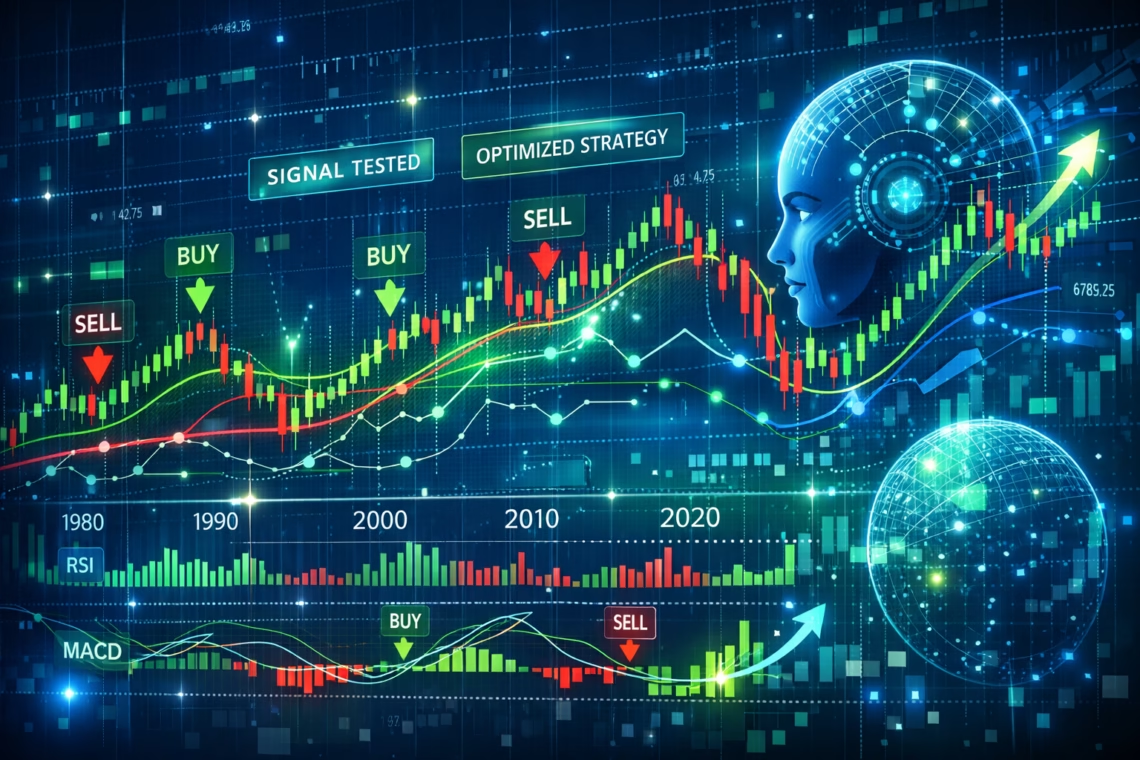
Deep historical backtesting involves applying a trading strategy to market data spanning many years—often decades—to test its viability across diverse economic cycles, booms, busts, and black swan events. Unlike shallow backtests that might cover just a few years, this method provides a more robust analysis by incorporating long-term trends and volatility. For instance, data from the 2008 financial crisis or the 2020 pandemic can reveal how a strategy holds up under extreme conditions.
At its core, deep historical backtesting uses tools like Python libraries (e.g., Backtrader or Zipline) or platforms such as TradingView to replay historical prices, volumes, and indicators. This simulation estimates potential returns, drawdowns, and win rates, offering a data-driven foundation for strategy development.
The Key Benefits of Deep Historical Backtesting
Why prioritize deep historical backtesting? It builds confidence in your strategies by validating them against real-world history. One major benefit is risk management: by identifying maximum drawdowns over extended periods, traders can avoid over-optimistic assumptions based on short-term bull markets.
Another advantage is edge identification. Strategies that perform well in deep historical backtesting often have a statistical edge, reducing the chances of curve-fitting—where a model is overly tuned to past data but fails in live trading. Additionally, it promotes discipline, as backtested results discourage emotional trading decisions.
In quantitative trading, deep historical backtesting is indispensable for algorithmic systems, ensuring they adapt to regime shifts like inflation spikes or geopolitical tensions. Recent studies show that strategies backtested over 20+ years yield 15-30% more reliable predictions during volatile periods.
How to Perform Deep Historical Backtesting Effectively
To conduct deep historical backtesting, start with high-quality data sources. Platforms like Yahoo Finance, Alpha Vantage, or premium providers such as Tick Data offer decades of tick-level information for stocks, forex, and futures. Ensure your dataset includes survivorship bias adjustments to avoid skewed results from delisted assets.
Next, define your strategy rules—entry/exit signals, position sizing, and stop-losses—then run simulations. Tools like QuantConnect or Amibroker allow for walk-forward optimization, testing in-sample and out-of-sample periods to mimic real trading. Always account for slippage, commissions, and liquidity to make results realistic.
For automation enthusiasts, integrating deep historical backtesting with platforms like PickMyTrade can streamline the process. PickMyTrade automation trading connects seamlessly with TradingView, enabling users to backtest strategies historically before automating live execution on brokers like Tradovate or Rithmic. This no-code solution is ideal for traders seeking to validate long-term strategies without extensive programming.
Recent Updates in Deep Historical Backtesting (2023-2026)
The landscape of backtesting has evolved rapidly. From 2023 to 2026, AI integration has become prominent, with tools like TrendSpider’s AI optimizer reducing prediction errors by 15-30% in volatile markets through enhanced datasets blending historical ticks with sentiment analysis.
In 2025, advancements in cloud-based platforms improved access to granular data, allowing for faster simulations of decades-long periods. Deep learning models, as highlighted in systematic reviews, now incorporate macroeconomic factors for more accurate algorithmic trading backtests. By early 2026, updates in TradingView and similar ecosystems emphasize forward testing alongside historical data to bridge the gap between simulation and reality.
PickMyTrade has kept pace, updating its automation features in 2025 to support deeper historical datasets directly from TradingView, making it easier for users to test strategies over extended timelines before going live.
Click Here to Automate on Futures Trading
Challenges and Best Practices
Despite its value, deep historical backtesting isn’t foolproof. Overfitting remains a risk, where strategies excel in the past but falter live. Data quality issues, like gaps in historical records, can also mislead results.
To mitigate, use out-of-sample testing and Monte Carlo simulations for robustness. Combine with forward testing in demo accounts to validate findings. Platforms like PickMyTrade automation trading help by offering seamless transitions from backtesting to automated execution, reducing slippage in real markets.
Conclusion
Deep historical backtesting is more than a tool—it’s a cornerstone for building resilient trading strategies. By leveraging extensive data and modern platforms, traders can gain a competitive edge in unpredictable markets. Whether using free resources or advanced automation like PickMyTrade, investing time in this practice pays dividends.
Most Asked FAQs
Backtesting uses historical data to evaluate strategies, while deep historical backtesting extends this to longer periods (e.g., 20+ years) for comprehensive insights across market cycles.
Ideally, 10-30 years or more, covering multiple economic phases to ensure reliability.
No, it’s a simulation tool for risk assessment, not a predictor, as markets evolve.
Platforms like TradingView, QuantConnect offer robust features for historical simulations.
Disclaimer:
This content is for informational purposes only and does not constitute financial, investment, or trading advice. Trading and investing in financial markets involve risk, and it is possible to lose some or all of your capital. Always perform your own research and consult with a licensed financial advisor before making any trading decisions. The mention of any proprietary trading firms, brokers, does not constitute an endorsement or partnership. Ensure you understand all terms, conditions, and compliance requirements of the firms and platforms you use.
Also Checkout: Delta Neutral Algo Trading 2026 Guide