Your strategy looked flawless on the chart — clean entries, tight stops, and a smooth equity curve marching upward. Then you went live… and watched it unravel in days. You’re not alone. According to industry data, 72% of day traders end the year with losses, while only 1% remain consistently profitable after five years. The real killer isn’t usually the strategy itself — it’s the massive gap between backtested results and live-market performance. This guide compares market replay backtesting and live testing side-by-side, so you can choose the approach that truly prepares you for trading with real capital at risk.
Key Takeaways
- Only 1% of day traders stay profitable after five years — testing methodology often matters more than the strategy.
- Market replay bridges the divide between static backtesting and live trading by adding real-time emotional pressure.
- Slippage and execution costs can cut backtest returns in half or worse.
- The smartest path? Combine market replay for rapid refinement with controlled live testing (e.g., via platforms like PickMyTrade) for final validation.
Why Backtested Strategies Often Fail Live
A landmark study of 888 crowd-sourced algorithms on Quantopian found almost zero correlation (R² < 0.025) between backtested Sharpe ratios and actual out-of-sample live performance. In other words, impressive backtests rarely predicted real-world success.
The usual suspects are:
1. Overfitting Optimizing too aggressively on historical data makes your strategy fit noise rather than true market behavior. It performs brilliantly on past data but collapses when conditions change.
2. Slippage and Execution Costs Backtests assume perfect fills at ideal prices. In reality, slippage can range from 0.1% in liquid markets to over 1% in thinner ones — enough to destroy profitability.
3. Emotional and Psychological Factors Backtests have no fear, greed, hesitation, or revenge trading. Live markets test your discipline in ways no spreadsheet ever can.
Key Insight: The backtest-to-live gap is rarely just about data quality — it’s primarily a psychology and execution problem. Market replay is designed to address exactly that.
What Is Market Replay Backtesting?
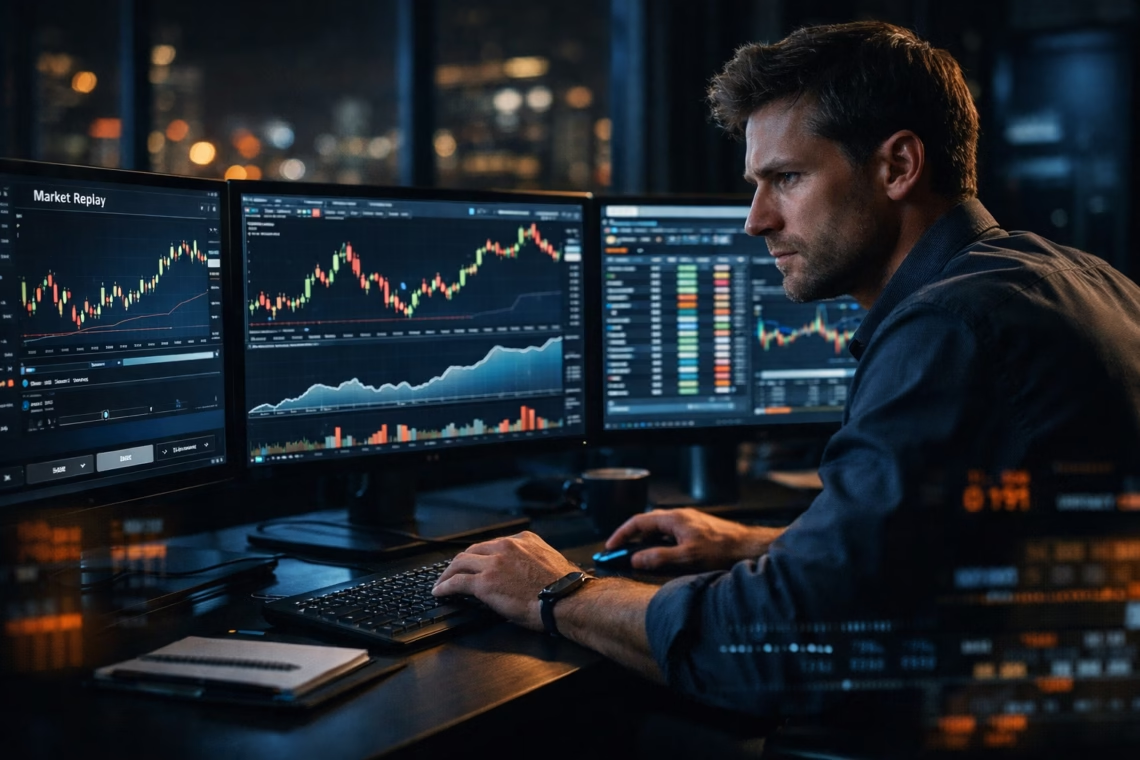
Market replay lets you replay historical market data tick-by-tick or candle-by-candle as if it were happening in real time. Unlike traditional backtesting (where you see the entire dataset at once), replay hides the future and forces you to make decisions under live-like conditions.
As algorithmic trading grows rapidly, the demand for realistic testing has never been higher.
What makes market replay backtesting unique:
- Real time pressure — you can’t pause for deep analysis.
- No forward-looking bias — you don’t know what happens next.
- Emotional simulation — you experience drawdowns, FOMO, and hesitation without risking money.
- Targeted practice — replay specific high-impact events (earnings, FOMC, volatility spikes) to sharpen pattern recognition.
Standard backtesting is like reading about swimming. Market replay is practicing in the pool. Live trading is the open ocean.
How Does Live Testing Compare?
Live testing (paper trading or small real-money accounts) exposes your strategy to actual order flow, genuine slippage, latency, and market impact.
The statistics are harsh: only 13% of day traders stay profitable beyond six months, and just 1% survive five years. Live testing helps you find out — early — whether your edge belongs to the tiny profitable minority.
What live testing reveals:
- True slippage and fill quality.
- Execution latency in real conditions.
- Your own psychological endurance under real P&L pressure.
- Market impact from your orders (especially in lower-liquidity instruments).
Downside: It’s slow. You can’t fast-forward through quiet periods or instantly replay rare events.
Market Replay Backtesting vs Live Testing: Head-to-Head
Here’s a clear comparison across the factors that matter most:
| Factor | Market Replay | Live Testing |
|---|---|---|
| Speed | Excellent – replay weeks in hours | Slow – real time only |
| Emotional Realism | Moderate (no real money at risk) | High (real P&L feels very different) |
| Slippage Accuracy | Low (simulated) | High (real execution data) |
| Cost | Low or free | Real commissions + potential losses |
| Scenario Coverage | Excellent – any historical period | Limited to current market conditions |
| Best For | Fast iteration & pattern recognition | Final validation before scaling |
Bottom line: Neither is sufficient alone. Market replay excels at rapid learning and refinement. Live testing provides the ultimate reality check.
Practical Tip: Use market replay to iterate quickly and build confidence. Then move to small-size live testing. Only scale up after 50–100 live trades confirm the results hold.
Click Here To Automate Futures Trading
The Smart Way: Combine Both Methods
A proven four-step testing pipeline dramatically improves your odds:
- Standard Backtest — Test 2–5 years of data. Kill weak ideas early.
- Market Replay Validation — Replay challenging periods (high volatility, news events). Test your ability to execute under pressure.
- Small-Size Live Testing — Use minimal capital on a platform like PickMyTrade, which automates TradingView signals to your broker. This gives real slippage and execution data with reduced emotional interference.
- Compare & Scale — If live results stay within 20–30% of replay performance, consider scaling. If the gap is large, return to replay for further refinement.
Automation helps here: By removing manual order entry, you isolate strategy performance from human execution errors.
What About Paper Trading?
Paper trading is better than nothing, but it has limitations. Without real money at risk, the psychological pressure is artificial. It also lacks the selectivity of market replay — you’re forced to sit through boring periods instead of targeting key setups.
Use paper trading as a quick bridge to verify your broker’s platform behavior before going live with real capital.
Frequently Asked Questions
No. It can’t replicate true slippage, order-book dynamics, or the emotional weight of real money. Use replay for speed and iteration, then validate with live testing.
Aim for at least 50–100 trades across different market conditions. This provides enough statistical relevance to compare against replay results.
It significantly reduces emotional and execution errors, but slippage and latency still exist. Tools like PickMyTrade help shrink the gap by automating signal execution.
Severe overfitting — using too many parameters tuned too closely to recent data. Keep rules simple and test across multiple market regimes.
The Bottom Line
Most day traders quit within two years. The ones who survive aren’t necessarily smarter — they’re simply better tested.
Market replay and live testing aren’t rivals. They’re complementary stages in a robust testing process:
- Use market replay to iterate fast and build skills cheaply.
- Use live testing to prove your strategy survives real-market friction.
- Automate execution (e.g., via PickMyTrade) to minimize human error.
Follow this disciplined approach, and you’ll greatly improve your chances of joining the small percentage of traders who actually succeed — instead of adding to the 72% who lose.
Disclaimer:
This content is for informational purposes only and does not constitute financial, investment, or trading advice. Trading and investing in financial markets involve risk, and it is possible to lose some or all of your capital. Always perform your own research and consult with a licensed financial advisor before making any trading decisions. The mention of any proprietary trading firms, brokers, does not constitute an endorsement or partnership. Ensure you understand all terms, conditions, and compliance requirements of the firms and platforms you use.
Also Checkout: Best VPS for Trading 2026: Low-Latency Ranked