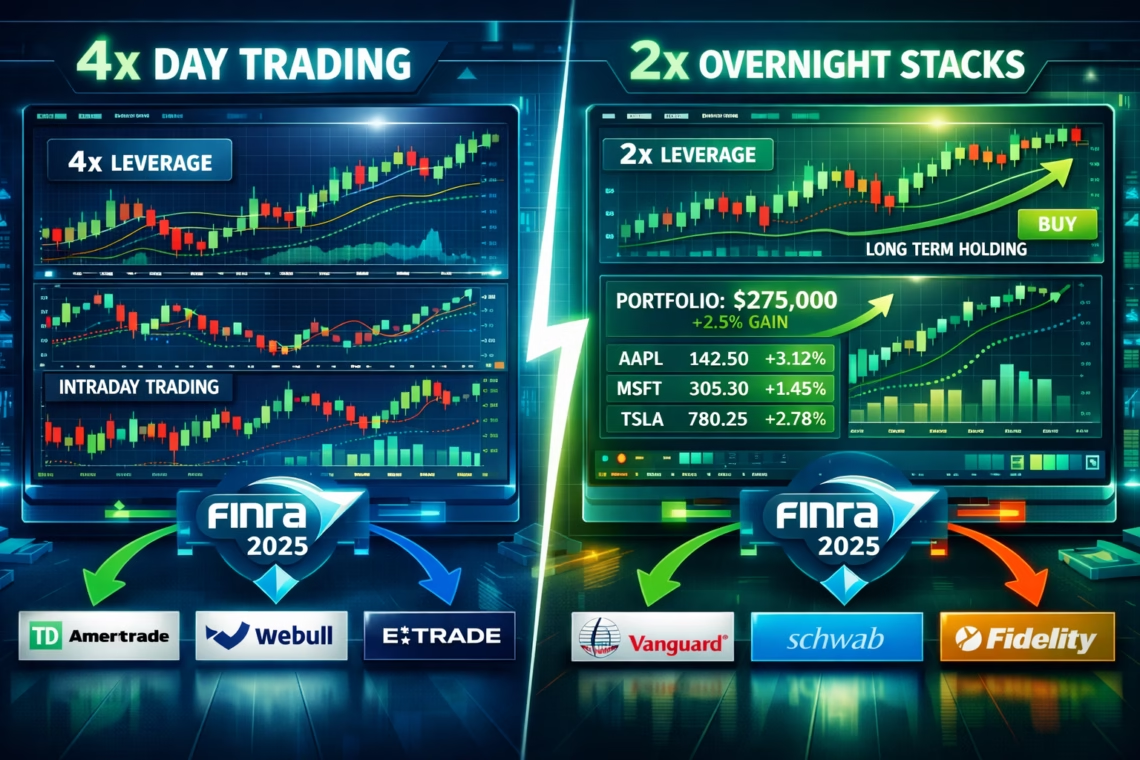
In the fast-paced world of retail trading, grasping day trading buying power can mean the difference between capitalizing on quick market moves and facing unexpected restrictions. As of September 2025, the Financial Industry Regulatory Authority (FINRA) has overhauled the Pattern Day Trader (PDT) rules, ditching the old $25,000 minimum equity barrier for a more flexible, risk-based approach. This shift opens doors for smaller accounts while tying intraday leverage to actual position risks rather than a blanket 4x multiplier. Meanwhile, stock buying power remains the steady foundation for longer holds. This guide breaks down these concepts, highlights fresh updates, and shows how to automate strategies using PickMyTrade—empowering retail traders to trade smarter without the guesswork.
Whether you’re scalping volatile stocks or building swing positions, understanding these levers ensures you maximize efficiency and sidestep margin pitfalls. Let’s dive in.
What Is Stock Buying Power?
Stock buying power represents the total funds at your disposal for acquiring equities, blending cash reserves with borrowed margin. For retail traders, it’s the go-to metric for overnight or multi-day positions, governed by standard margin rules from the SEC and FINRA.
Typically, brokers offer 2:1 leverage on margin accounts—meaning for every $1 of your own money, you can control $2 in stocks. This applies across stocks, ETFs, and sometimes options, but excludes the heightened intraday boosts.
How Leverage Shapes Stock Buying Power
Leverage here isn’t about speed; it’s about sustainability. Calculate it simply: Stock Buying Power = Cash Balance + (Account Equity × Leverage Ratio). A $15,000 cash deposit in a margin account yields $30,000 in buying power. Hold that position overnight? No problem—as long as maintenance margins (often 25-30% of the position value) are met.
Key Takeaway: Use stock buying power for conservative builds, like accumulating blue-chip stocks during earnings season.
Understanding Day Trading Buying Power
Day trading buying power (often abbreviated as DTBP) fuels same-day entries and exits, letting you amplify trades with higher leverage during market hours. It’s designed for active retail traders chasing intraday volatility, but positions must flatten by 4 p.m. ET to avoid reverting to overnight rules.
Pre-2025, DTBP capped at 4x your equity for pattern day traders (those averaging four+ round-trips weekly). Now, under the new FINRA framework effective October 2025, it’s dynamic: based on real-time margin requirements per trade, not a fixed multiple. Smaller accounts (as low as $2,000) can now qualify, provided risk controls like position limits are in place. This makes day trading buying power more accessible, but it demands precise risk management to dodge calls.
The 2025 FINRA Updates to PDT Rules
FINRA’s September 2025 amendments scrapped the rigid $25,000 PDT threshold, introducing a “portfolio margin” model for intraday trades. Brokers must now assess buying power per security’s volatility—e.g., a stable ETF might allow near-4x, while a meme stock caps at 2x. Verify with your broker, as implementation varies; check FINRA’s site for the latest filings (as of December 2025, SEC approval is complete).
Example: A $10,000 account previously locked out of PDT now supports $20,000-$40,000 in DTBP, scaled to trade size.
Key Differences: Day Trading Buying Power vs. Stock Buying Power
Retail traders often blur these lines, leading to overextended positions. Here’s a scannable breakdown:
| Aspect | Day Trading Buying Power (DTBP) | Stock Buying Power |
|---|---|---|
| Leverage Ratio | Up to 4x (now risk-adjusted post-2025) | Standard 2:1 for overnight holds |
| Usage Window | Intraday only—close by market end | Flexible; supports multi-day positions |
| PDT Applicability | Yes (updated rules: $2k min, risk-based) | No restrictions |
| Risk Profile | High volatility tolerance; quick margin calls | Lower; maintenance-focused |
| Ideal For | Scalps, momentum plays | Swings, value investing |
These distinctions shine in volatile sessions—DTBP lets you ride a 2% intraday spike on TSLA, while stock buying power suits holding through earnings.
Click Here To Automate Futures Trading
Automating Your Day Trading Strategy with PickMyTrade
Manual trades eat time and invite errors, especially with day trading buying power‘s tight windows. Enter PickMyTrade: a webhook-driven platform that bridges TradingView alerts to brokers like Tradovate, Rithmic, or Interactive Brokers (IB). No coding required—set it once, trade on autopilot.
Best Practices: Use paper trading first; integrate with IB’s TWS for advanced routing.
Real-World Use Cases: Harnessing Day Trading Buying Power
Automation via PickMyTrade transforms theory into profits. Here are five scenarios where day trading buying power edges out stock buying power, with sample alert templates.
- Momentum Scalp on Earnings: NVDA gaps up 3% pre-market. Use DTBP for a $20k position (on $10k equity). Alert Template: “RSI>70 AND price>EMA20 → Buy 100 shares, SL -1%, TP +2%.”
- Volatility Breakout: SPY breaks resistance amid Fed news. Automate entries to capture 0.5% moves without overnight risk. Alert: “Volume>2x avg AND close>high → Long, qty=DTBP*0.1.”
- Pairs Trade Rebalance: Short QQQ, long IWM on sector rotation. DTBP allows quick adjustments. Alert: “QQQ<200MA → Sell 50, hedge IWM buy.”
- News-Driven Fade: Crypto ETF dips on regulation rumors—buy low, sell high intraday. Alert: “Price<BB_lower → Market buy, exit EOD.”
- Algo Mean Reversion: EUR/USD forex pair (via IB) reverts to VWAP. Scale with risk-adjusted DTBP. Alert: “Deviation>2SD → Entry, TP=mean.”
These keep you under PDT radars while scaling wins.
Benefits and Limitations of Day Trading Buying Power
Benefits:
- Amplified Gains: Risk-adjusted leverage (post-2025) boosts returns on winners by 2-4x.
- Accessibility: No $25k wall—ideal for retail starters with $2k+.
- Precision Automation: Tools like PickMyTrade enforce DTBP caps, reducing emotional trades.
Limitations/Risks:
- Margin Calls Spike: Intraday swings can wipe 50%+ equity fast—hypothetical: a 5% adverse move on 4x leverage equals 20% loss.
- Time Pressure: Must exit by close; automation helps, but tech glitches hurt.
- Broker Variance: Not all platforms updated for 2025 rules yet—confirm via FINRA filings.
Common Mistakes and Fixes in Managing Buying Power
Retail traders trip on basics: confusing DTBP with overnight holds (fix: set EOD auto-exits in PickMyTrade). Another: Ignoring 2025 PDT flexibility, sticking to cash accounts (upgrade to margin for leverage). Over-relying on 4x myths post-updates leads to rejected orders—monitor real-time power in your broker app.
Advanced Tips
- Layer Positions: Use DTBP for 70% entry, stock BP for trailing stops.
- Volatility Filters: In alerts, add “IV<50%” to avoid over-levered wildcards.
- Backtest with 2025 Rules: Simulate in TradingView using updated margin calcs.
Most-Asked FAQs
Post-FINRA updates, it’s $2,000 with risk-based margins—no more $25k PDT wall, but check your broker.
Stock BP uses 2:1 leverage for holds; DTBP is intraday-focused with higher, adjustable leverage.
Expect a margin call; deposit funds within 5 days or face restrictions—use alerts to monitor.
Absolutely, but T+2 settlement delays funds; margin unlocks leverage for active traders.
They enable DTBP access under $25k via per-trade risk assessments, boosting retail participation.
Disclaimer:
This content is for informational purposes only and does not constitute financial, investment, or trading advice. Trading and investing in financial markets involve risk, and it is possible to lose some or all of your capital. Always perform your own research and consult with a licensed financial advisor before making any trading decisions. The mention of any proprietary trading firms, brokers, does not constitute an endorsement or partnership. Ensure you understand all terms, conditions, and compliance requirements of the firms and platforms you use.
Also Checkout: Understanding How to Avoid Pattern Day Trader (PDT) Status