In the fast-evolving world of financial markets, quant trading vs algo strategy remains a hot topic for traders seeking data-driven edges. As AI, machine learning, and automation advance rapidly, understanding quant trading vs algo strategy helps retail and institutional traders choose the right approach. This updated guide explores definitions, differences, advantages, recent trends as of early 2026, and practical tools like PickMyTrade for seamless automation.
What Is Quantitative Trading (Quant Trading)?
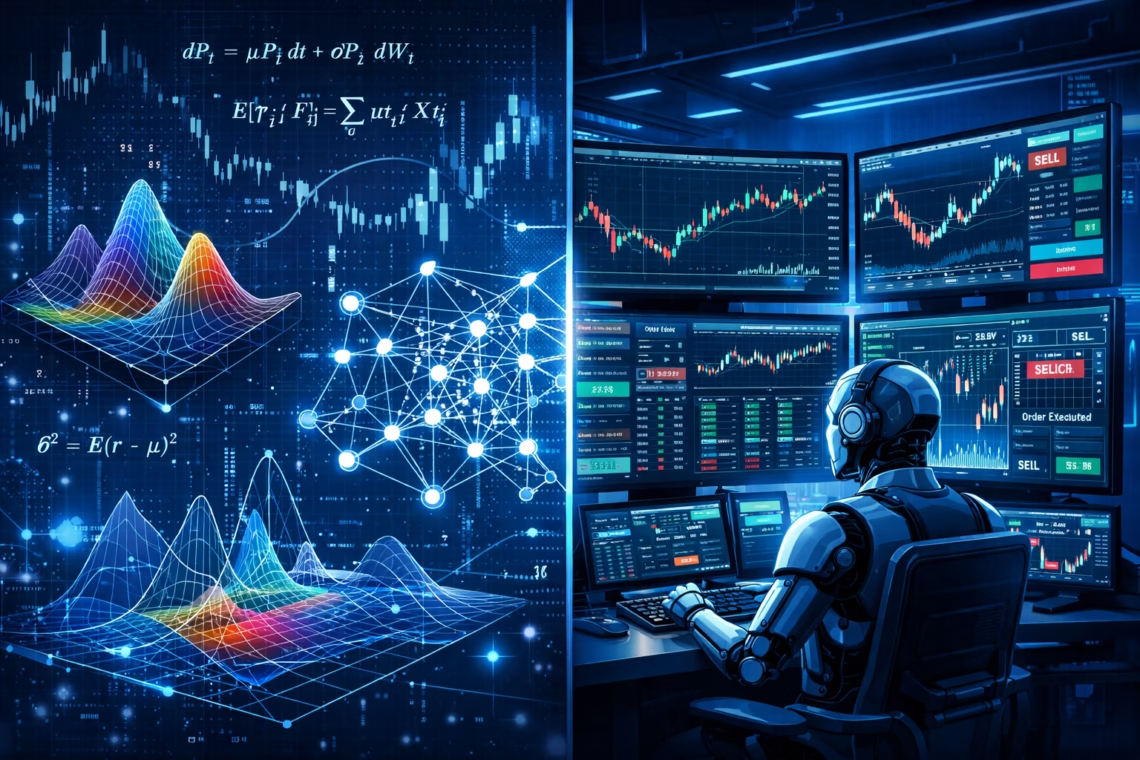
Quantitative trading, often called quant trading, uses advanced mathematical models, statistical analysis, and large datasets to develop and refine trading strategies. Quants focus on the “why” behind market movements, building predictive models from historical and alternative data (e.g., economic indicators, sentiment, or unstructured sources).
Quant strategies include statistical arbitrage, machine learning-based predictions, and factor models. This approach demands deep expertise in math, statistics, and programming (Python, R, etc.). It’s common in hedge funds but increasingly accessible via tools.
What Is Algorithmic Trading (Algo Trading)?
Algorithmic trading, or algo trading, automates trade execution using predefined rules. It focuses on the “how”—executing orders efficiently, minimizing slippage, and handling high volumes at speed. Algo strategies often rely on technical indicators like moving averages, VWAP, or momentum signals.
Algo trading removes emotion, enables 24/7 monitoring, and supports high-frequency or low-latency trades. Many retail traders start here due to its accessibility.
Quant Trading vs Algo Strategy: Core Differences
While overlapping—most quant strategies use algo execution—the distinctions are clear:
- Focus: Quant trading emphasizes strategy development and research (data modeling, backtesting). Algo trading prioritizes execution automation.
- Complexity: Quant models are intricate, using multi-variable stats and ML. Algo strategies can be simpler, rule-based.
- Data Usage: Quant draws from diverse sources; algo often sticks to price/volume.
- User Base: Quant suits institutions/experts; algo is beginner-friendly for retail.
- Execution: Algo fully automates trades; quant may identify signals manually or via algo.
| Aspect | Quant Trading | Algo Trading (Algo Strategy) |
|---|---|---|
| Primary Goal | Strategy creation via math/models | Automated execution |
| Key Tools | Python, ML libraries, stats software | APIs, platforms, indicators |
| Skill Level | Advanced (math, data science) | Moderate (programming basics) |
| Typical Users | Hedge funds, institutions | Retail, day traders |
| Recent Edge | AI/ML integration | Zero-code automation |
Advantages of Quant Trading vs Algo Strategy
Quant Trading Advantages:
- Data-driven decisions reduce bias.
- Potential for higher alpha via complex models.
- Better risk management through simulations.
Algo Trading Advantages:
- Speed and precision in execution.
- Emotion-free, consistent trading.
- Scalability for multiple accounts/markets.
Many pros combine both: Develop quant models, then automate via algo execution for optimal results.
Recent Updates in Quant Trading vs Algo Strategy (2025-2026)
In 2025-2026, algo trading revenues surged (e.g., HFT at $10B+ in 2024, projected $16B by 2030), fueled by AI. Retail adoption grows 10%+ yearly via zero-commission brokers and APIs.
Trends include:
- AI/ML dominating predictions (deep learning for patterns).
- Quantum computing trials (e.g., HSBC-IBM bond trading optimization, up to 34% improvement).
- Zero-code platforms democratizing access—retail traders build complex strategies without coding.
- Focus on risk-aware, Monte Carlo-simulated strategies amid volatile markets.
Algo remains profitable when managed actively, not “set-and-forget.”
Click Here To Start Futures Trading Automation
How PickMyTrade Fits into Algo Strategy Automation
For retail traders bridging quant trading vs algo strategy, PickMyTrade stands out as a powerful no-code automated trading platform. It connects TradingView indicators/strategies to brokers like Tradovate, Rithmic, Interactive Brokers, TradeStation, and more.
Key features:
- Automate signals from RSI, Bollinger Bands, or custom alerts via webhooks.
- Unlimited trades, accounts, and strategies.
- Real-time execution with risk controls (stop-loss, take-profit).
- Ideal for futures, stocks, and day trading bots.
PickMyTrade simplifies algo strategy implementation—turn quant-inspired ideas into automated trades without deep coding. Join 3,000+ traders automating 24/7 with reliability and precision.
Which Approach Wins in 2026?
Neither purely wins—successful traders blend quant trading vs algo strategy. Start with algo for execution ease, then layer quant models for smarter signals. Tools like PickMyTrade make this accessible, especially for retail in volatile markets.
Explore automation today to stay competitive.
Most Asked FAQs on Quant Trading vs Algo Strategy
Quant trading focuses on building mathematical models for strategy development, while algo strategy automates trade execution based on rules.
Yes—platforms and zero-code tools democratize it, though it requires learning stats/ML.
Yes, especially with AI and proper management; it’s effective for scanning opportunities 24/7.
Most do for efficiency, but some identify signals manually.
PickMyTrade excels for TradingView-to-broker automation, supporting futures and more.
Disclaimer:
This content is for informational purposes only and does not constitute financial, investment, or trading advice. Trading and investing in financial markets involve risk, and it is possible to lose some or all of your capital. Always perform your own research and consult with a licensed financial advisor before making any trading decisions. The mention of any proprietary trading firms, brokers, does not constitute an endorsement or partnership. Ensure you understand all terms, conditions, and compliance requirements of the firms and platforms you use.
Also Checkout: Best Algorithmic Trading Software: Unlock Smarter Strategies