Introduction: Why Automated Trading Systems Now Define Professional Trading
Speed, consistency, and risk control now matter more than intuition. In modern futures, forex, and crypto markets, an Automated Trading Systems is no longer a luxury—it’s the foundation of scalable, professional trading.
From prop firm traders managing multiple funded accounts to quantitative teams deploying algorithmic strategies, automation is what separates repeatable performance from manual guesswork. The best systems don’t just place trades—they replicate strategies across accounts, enforce risk rules automatically, and operate 24/7 with near-zero latency.
This guide breaks down how automated trading systems work today, which platforms and tools matter, and why PickMyTrade stands out as a trader-first automated trading platform built for real-world execution—not retail shortcuts.
What Is an Automated Trading System?
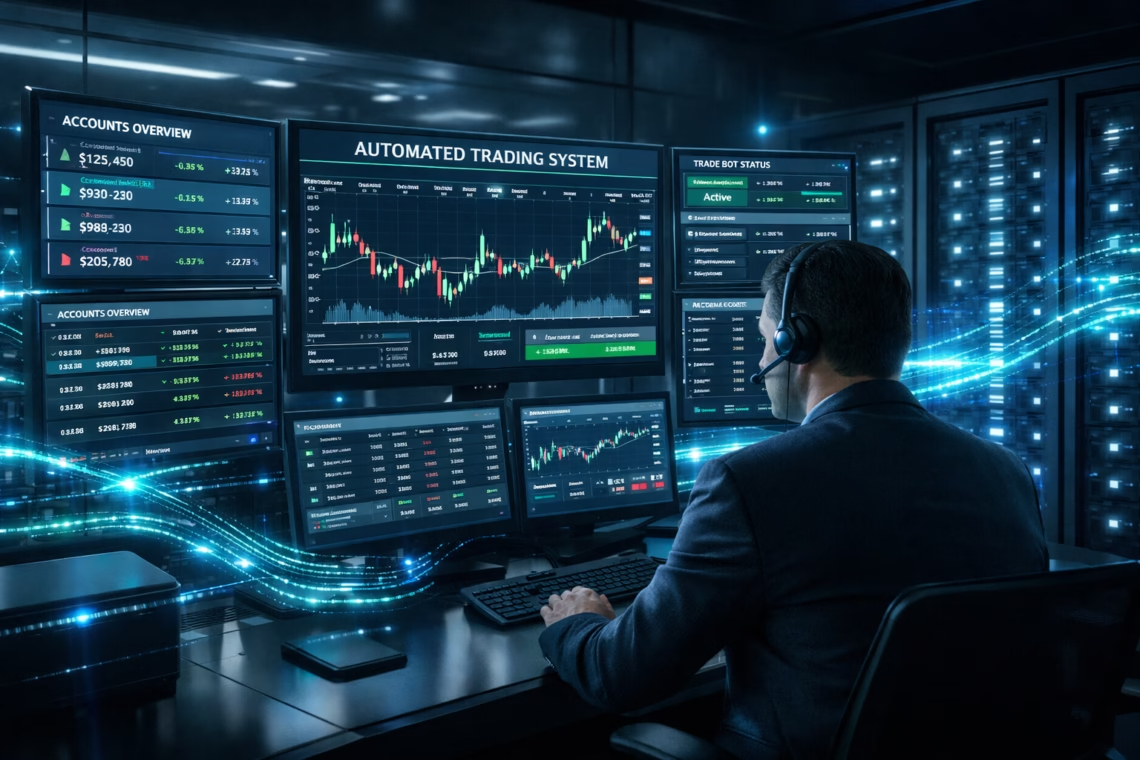
An Automated Trading System (ATS) is a rules-based framework that executes trades without manual input. These systems can be simple (copying trades between accounts) or highly advanced (AI-driven strategies operating across multiple markets).
At a professional level, an ATS typically includes:
- Strategy logic (manual, algorithmic, or hybrid)
- Trade execution engine
- Multi-account replication
- Proportional risk management
- Real-time monitoring and controls
- Low-latency infrastructure (VPS or cloud)
Unlike retail bots, professional automated trading systems are designed to scale, comply with prop firm rules, and maintain execution precision during volatility.
Why Automated Trading Systems Matter in 2026
Markets are faster, more fragmented, and more competitive than ever. Automation solves problems manual trading simply cannot.
Key advantages:
- Consistency – Same execution, every trade, every account
- Speed – Millisecond-level execution reduces slippage
- Scalability – One strategy, dozens of funded accounts
- Risk enforcement – Drawdowns, sizing, and limits handled automatically
- 24/7 operation – Systems don’t sleep, disconnect, or hesitate
For prop firm traders, automation is often the difference between passing evaluations once—and building a sustainable operation.
Core Components of a Professional Automated Trading System
1. Strategy Engine
This defines what to trade and when. Strategies may include:
- Discretionary trades mirrored automatically
- Algorithmic logic (momentum, mean reversion, order flow)
- Signal-based systems (TradingView, proprietary indicators)
- AI-assisted decision models
2. Trade Replication & Copy Engine
This is where most traders fail or succeed. A robust ATS must:
- Copy trades instantly across accounts
- Adjust position sizes proportionally
- Handle symbol mapping across brokers
- Prevent partial fills and desyncs
3. Risk Management Layer
Professional systems enforce rules automatically:
- Max daily loss
- Trailing drawdowns
- Contract caps per account
- News or volatility filters
4. Infrastructure (The Hidden Edge)
Even the best strategy fails without execution quality. That’s why serious traders rely on:
- Low-latency VPS or cloud execution
- Proximity to exchanges (Chicago, New York, London)
- Redundant networking and uptime guarantees
Popular Platforms Used in Automated Trading Systems
Most professional ATS setups are built on top of established trading platforms, enhanced with automation tools.
Futures-Focused Platforms
- PickMyTrade
- NinjaTrader
- Quantower
- Sierra Chart
- Tradovate
Multi-Asset Platforms
- PickMyTrade
- MetaTrader 5
- cTrader
- MultiCharts
- TradeStation
These platforms provide execution, charting, and broker access—but they are not complete automated trading systems on their own. The real power comes from how automation is layered on top.
Where Most Automated Trading Systems Fall Short
Many traders rely on generic copy traders or retail automation tools. Common issues include:
- Latency spikes during volatility
- Poor risk scaling across accounts
- No prop-firm-specific controls
- Manual intervention required during outages
- Limited transparency into execution logic
This is exactly where PickMyTrade changes the equation.
Why PickMyTrade Is Built Differently
PickMyTrade is not just another trade copier. It’s a trader-centric automated trading system designed specifically for professionals scaling strategies across multiple accounts.
What Makes PickMyTrade Superior
- True multi-account automation without fragile local setups
- Built-in proportional risk controls designed for prop firm rules
- Platform-agnostic architecture (futures, forex, crypto-ready)
- Cloud-native execution for uninterrupted 24/7 operation
- Execution transparency—no black-box behavior
Unlike generic tools that bolt automation onto retail platforms, PickMyTrade is engineered from the ground up for:
- Funded account scaling
- Portfolio-level automation
- Real-time risk enforcement
- Professional execution standards
Real-World Use Cases for Automated Trading Systems
Prop Firm Traders
- One master strategy replicated across Apex, FundedNext, and MFFU accounts
- Automatic sizing to meet trailing drawdown rules
- Centralized shutdown if risk thresholds are hit
Algorithmic Traders
- Deploy strategies once, execute everywhere
- Eliminate manual execution errors
- Monitor performance across accounts in real time
Portfolio Managers
- Manage multiple client or internal accounts
- Enforce uniform risk rules
- Scale capital without increasing workload
Hybrid Traders
- Manual decision-making with automated execution
- Faster fills without emotional interference
- Perfect consistency across trades
Infrastructure Still Matters (More Than Ever)
Even the best automated trading system depends on execution quality.
Professional traders pair automation with:
- Ultra-low latency VPS hosting
- Dedicated CPU and RAM resources
- NVMe storage for fast data access
- Redundant network paths
This ensures:
- No missed trades
- No platform downtime
- No execution lag during news or volatility
Best Practices for Building a Reliable Automated Trading System
- Test automation in simulation first
- Validate latency under live conditions
- Enforce risk rules at the system level
- Avoid local-only setups for live capital
- Use platforms designed for scaling—not experimentation
The Future of Automated Trading Systems
Automation is moving beyond simple copying into:
- Adaptive risk models
- AI-assisted execution logic
- Cross-asset portfolio automation
- Cloud-native trading stacks
Platforms like PickMyTrade represent this next phase—where automation is not an add-on, but the core trading engine. Click Here to Signup
Conclusion: Automation Is the New Trading Skill
In 2026, successful traders are not defined by how fast they click—but by how well their systems execute.
A professional Automated Trading System delivers:
- Speed without slippage
- Scale without chaos
- Risk without emotion
PickMyTrade stands out because it was built for traders who think long-term, scale intelligently, and demand execution they can trust.
If your goal is consistency, scalability, and control—automation isn’t optional anymore. It’s the edge.
Disclaimer:
This content is for informational purposes only and does not constitute financial, investment, or trading advice. Trading and investing in financial markets involve risk, and it is possible to lose some or all of your capital. Always perform your own research and consult with a licensed financial advisor before making any trading decisions. The mention of any proprietary trading firms, brokers, does not constitute an endorsement or partnership. Ensure you understand all terms, conditions, and compliance requirements of the firms and platforms you use.
Also Checkout: TradingView Alerts Automation: Guide to Hands-Free Trading